Our Lady of
Guadalupe Chapel
Galilee Center for Children
A place for prayer.
A home for belonging.
A day at the chapel to come: from the first jasmine garland at the gate to the lanterns glowing at dusk.
Come walk the chapel with me
Family, today you are our very first visitors.
I’ll walk with you today, from the moment the car turns in from the village road to the moment the lanterns glow behind you at dusk.
We’ll follow the visitor’s own path: the arrival court, the sampaguita walk, the round room and Our Lady at its heart, the story windows, the candles and the Stations, the covered garden walk and the rose garden, and the covered walkway to the Galilee home, whose hall is where every celebration ends in a shared meal. At dusk we’ll walk down to the three guest houses on the hill.
At every stop I’ll tell you what you’re looking at, where it comes from, and why it belongs here in Bigo.
With gratitude,
Your guide
Morning jasmine to evening lanterns
One easy walk from the arrival court into the round chapel, out along the covered garden walk to the rose garden, and across the covered walkway to the Galilee home and its hall, with shade, seats and a level path the whole way. At dusk, a lantern-lit path leads down to the guest houses.
Arrival
A warm welcome on the forecourt.
The sampaguita walk
A fresh garland for Lola.
Step inside
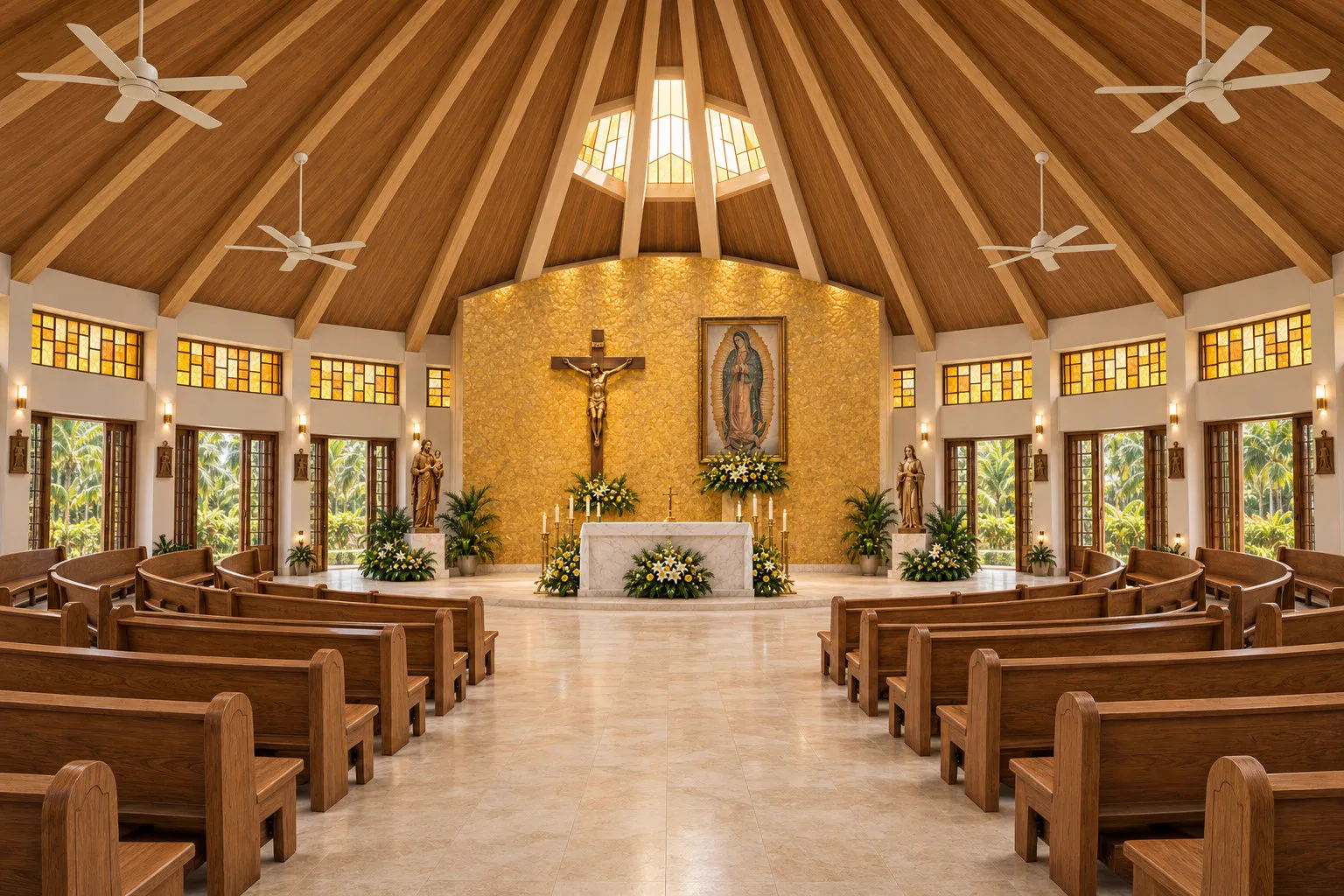
Timber ribs rising to a crown of light.
A place together
One hundred places, close to the altar.
Our Lady at the center
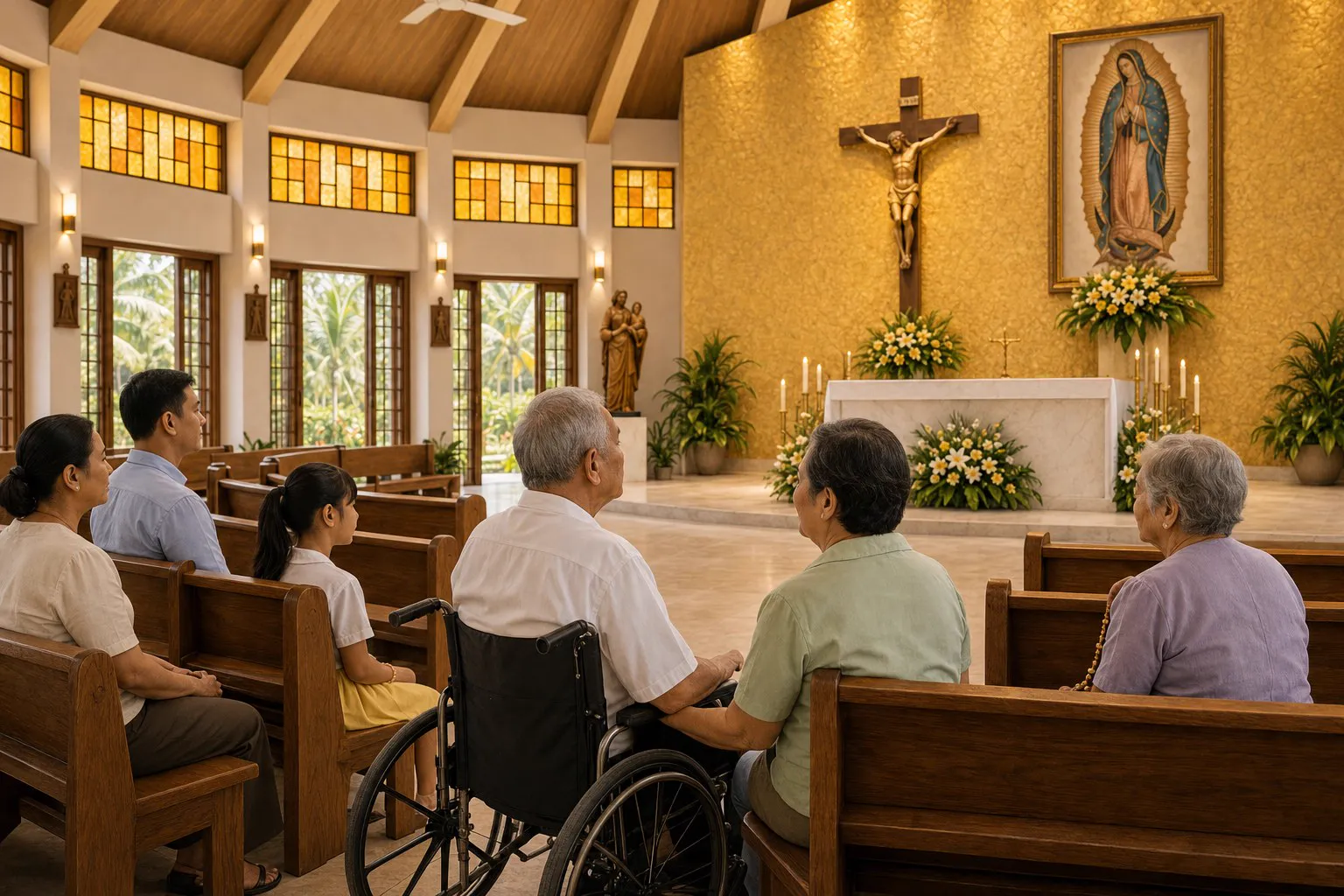
A quiet prayer before her image.
The story windows
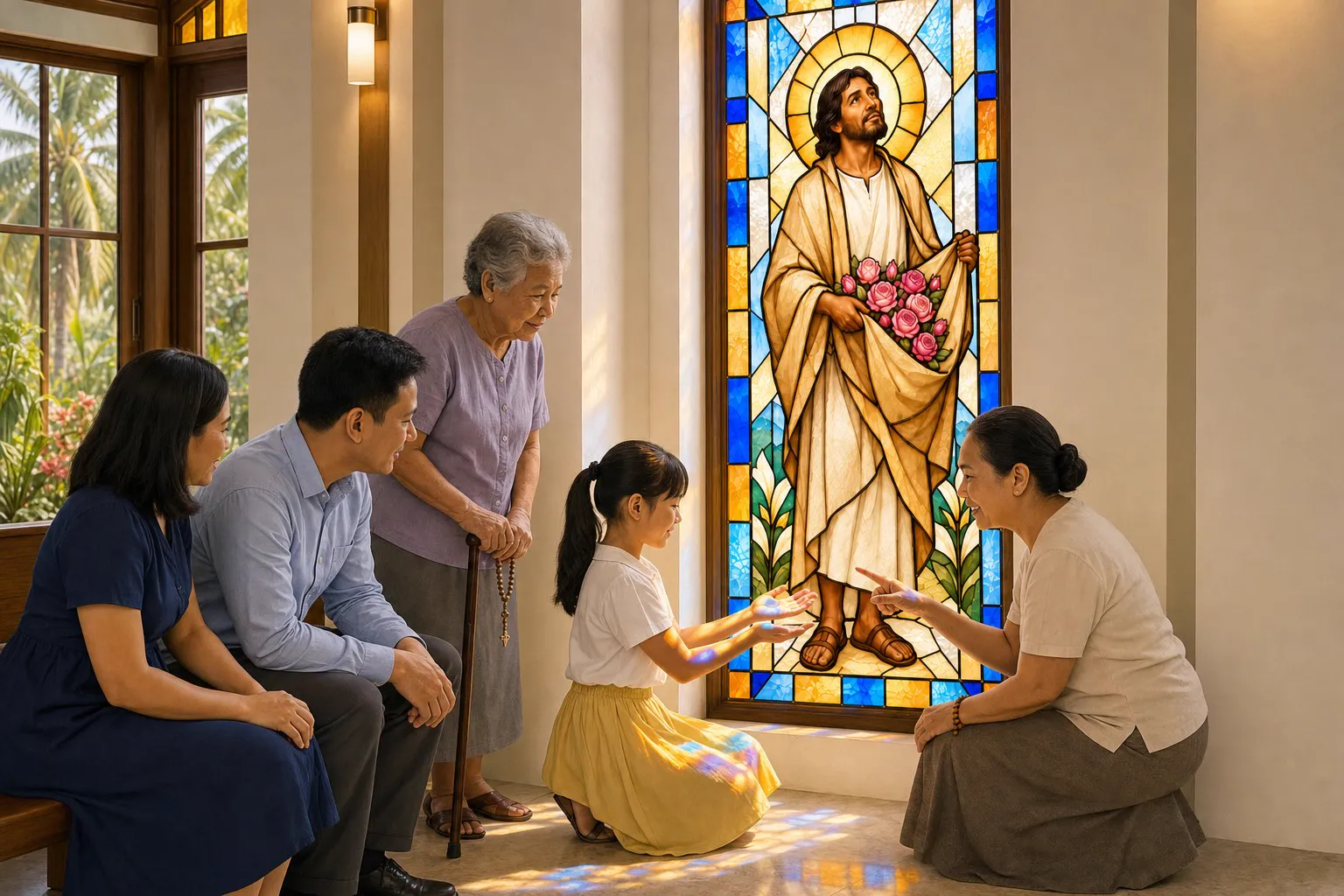
Colored light in a child’s hands.

A candle for someone
Beside the sampaguita ribbon.
The Stations
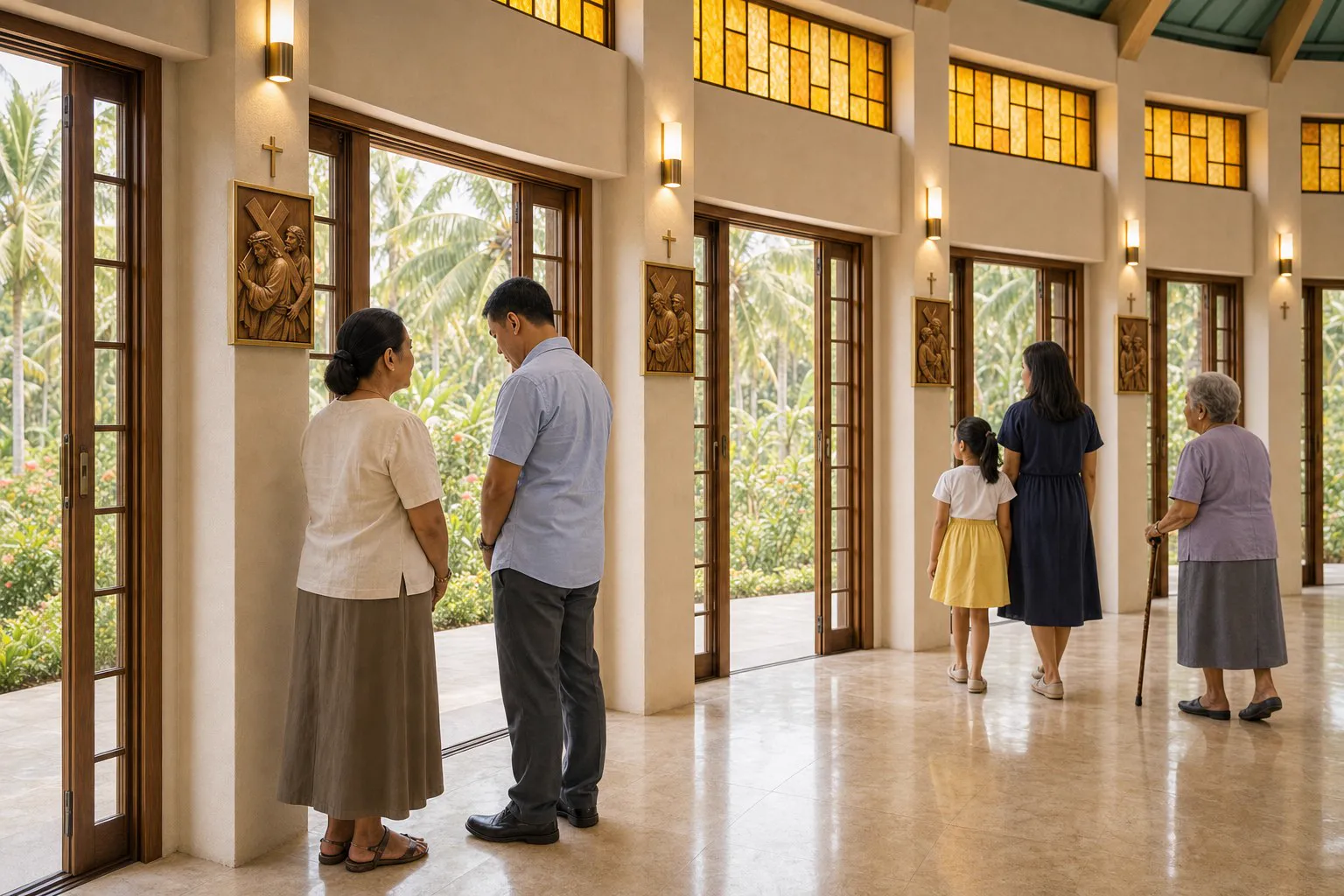
Fourteen carved panels on the curving wall.
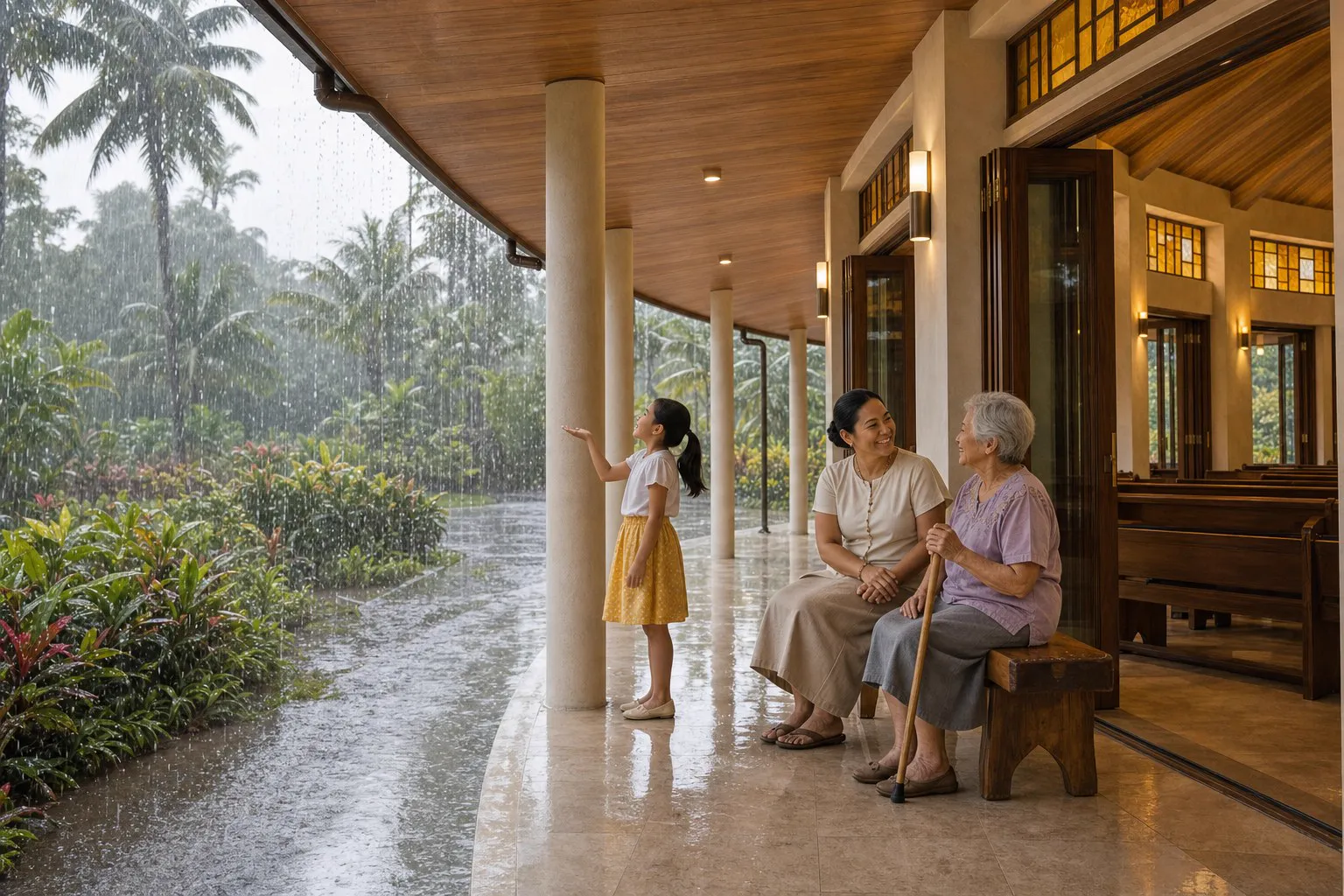
The covered walk
Shade, breeze and a passing shower.
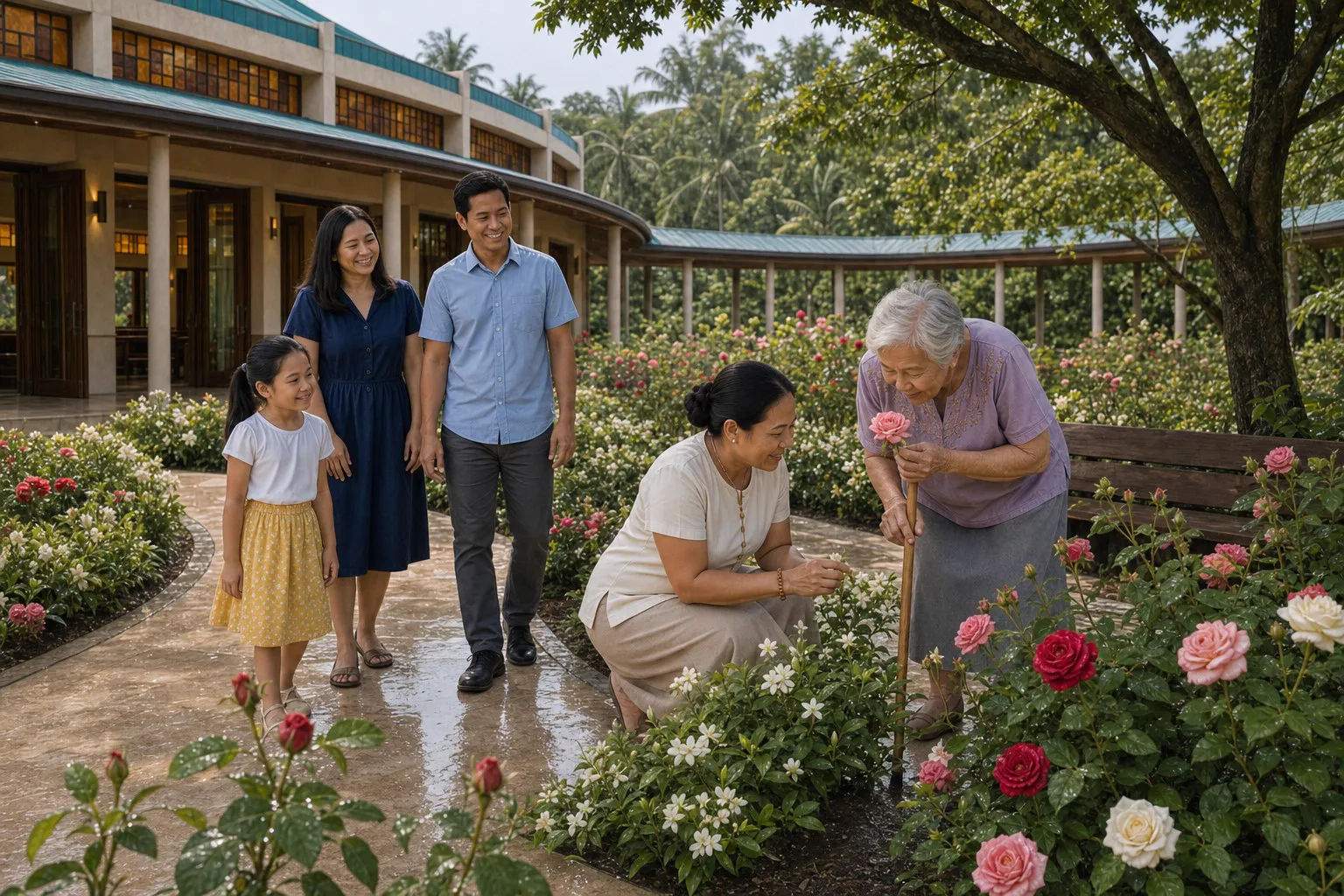
The rose garden
Roses and sampaguita behind the chapel.
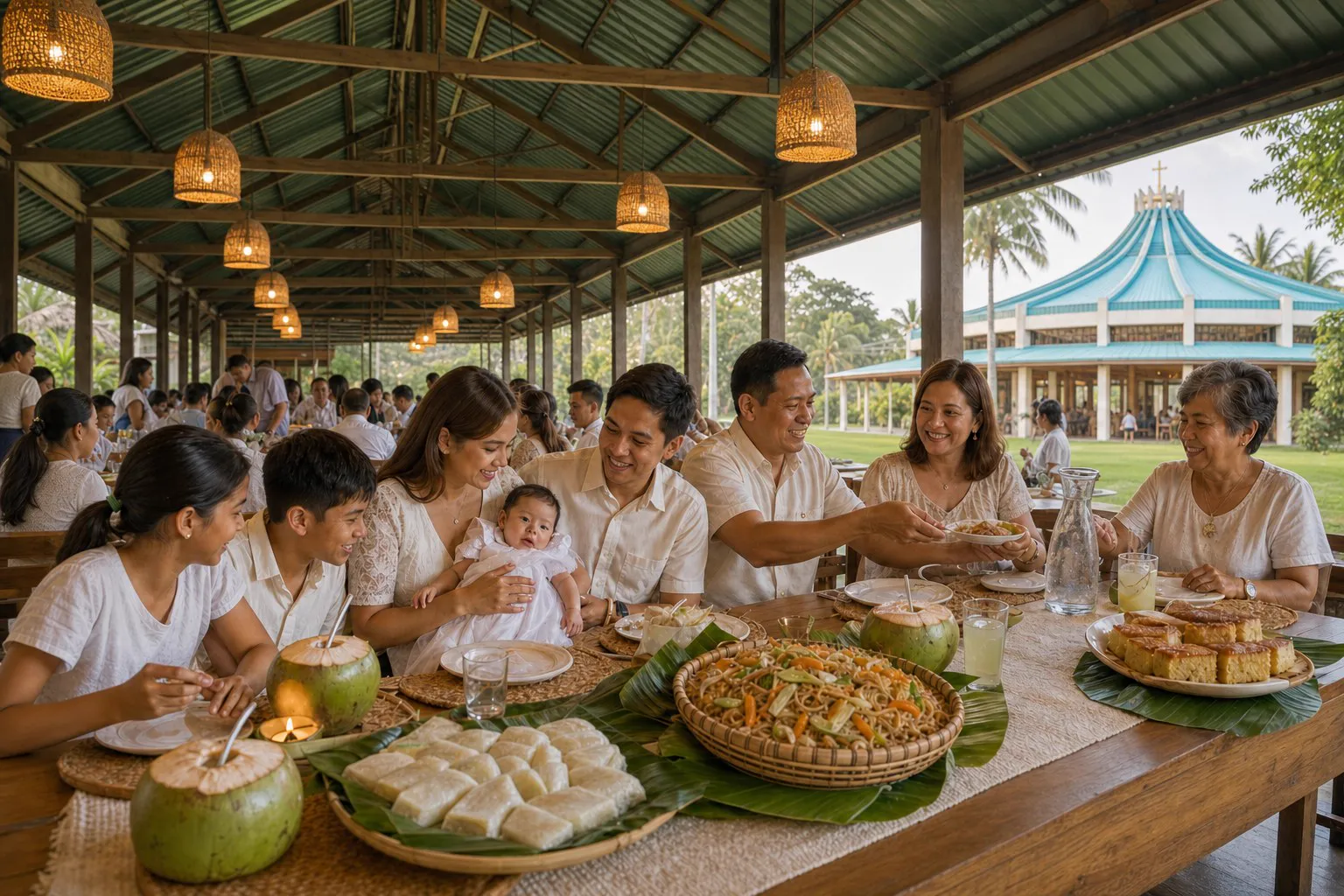
The Galilee home and its hall
A salu-salo after the baptism.
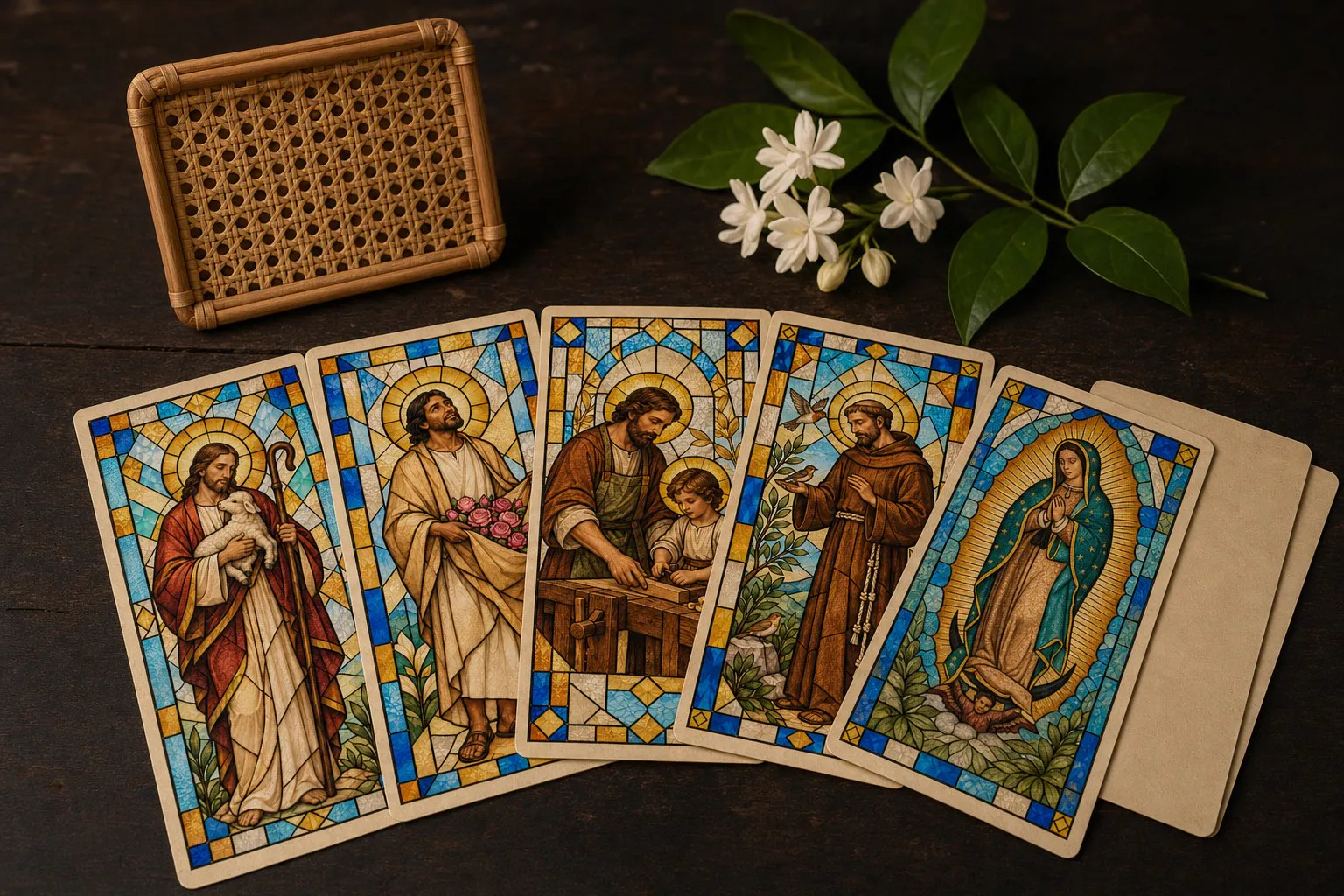
Keepsakes
Candles, rosaries and prayer cards.
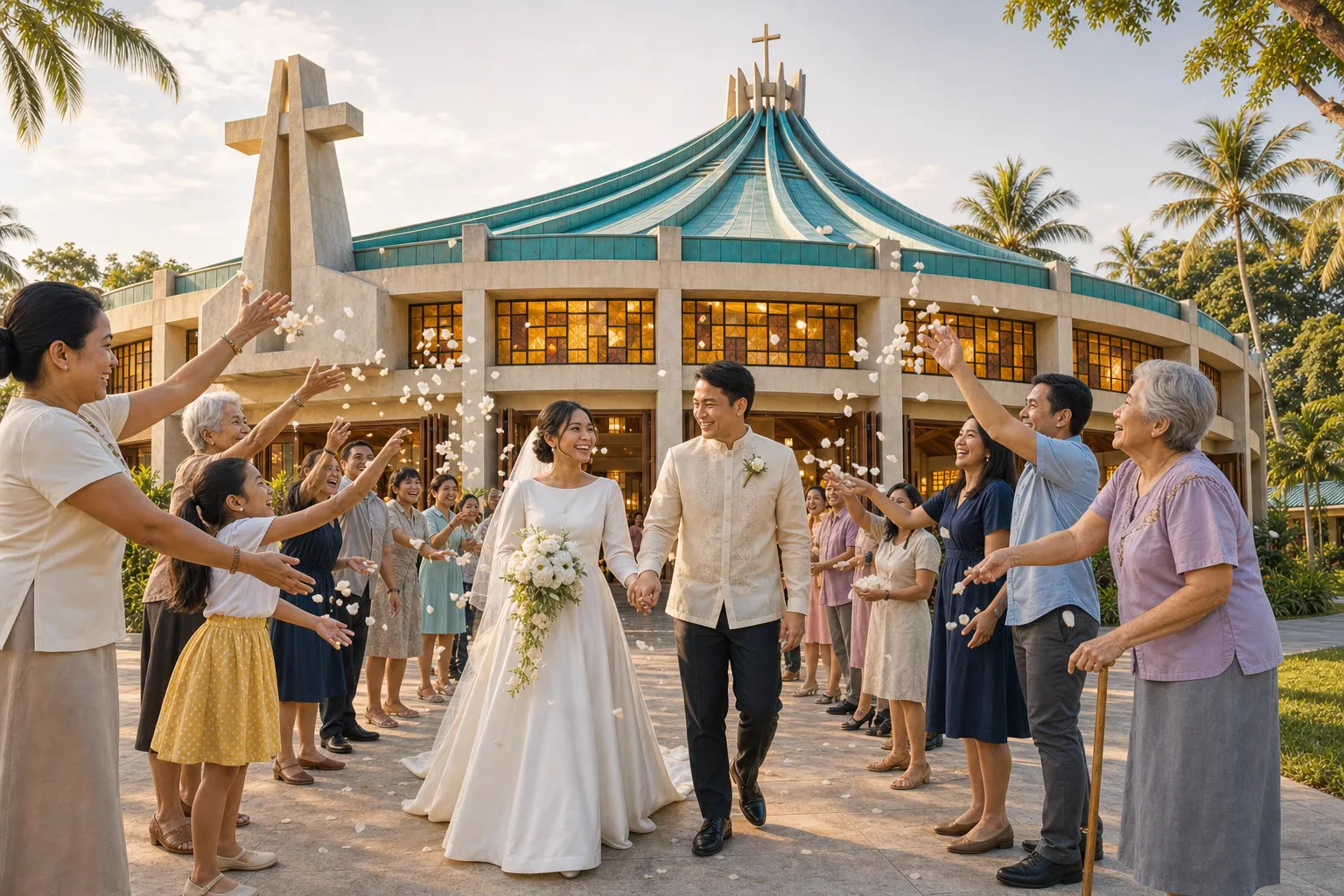
Life’s big days
A wedding in the golden light.
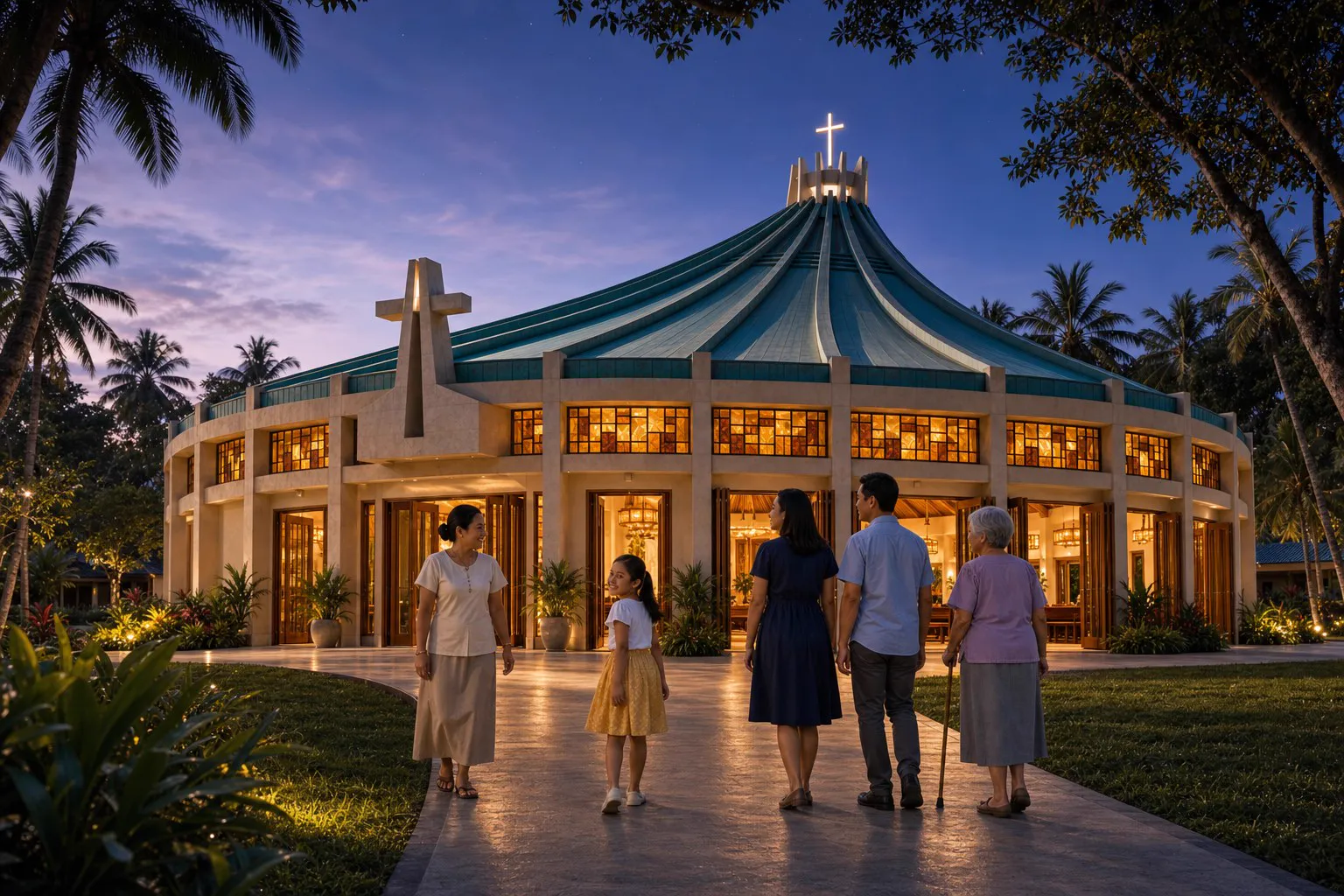
Lanterns at dusk
The whole chapel glowing from within.

The guest houses
Three homes glowing on the hill.

Coconut Country
Our story begins in Barangay Bigo, a small hillside community on the western edge of Pagbilao, next to Lucena City. Morning mist lies in the valleys, and on a clear day Mount Banahaw rises on the horizon.

Bigo, Pagbilao, Quezon
A small hillside barangay of about 1,300 people, three to four hours from Manila, just past Lucena City.
Pagbilao goes back to the Spanish era. The town dates itself to 1725, and its name is said to join two everyday things: the papag, a bamboo bed, and the bilao, a woven winnowing tray. The town’s parish church is dedicated to Saint Catherine of Alexandria, in the Diocese of Lucena, and about 82,000 people call the town home.
This is coconut country. Quezon plants more coconut than any other province in the Philippines, and every August it gives thanks for the harvest with the Niyogyugan Festival. In nearby Lucban, houses dress in rice and kiping for Pahiyas each 15 May, and next door Tayabas tosses suman from its windows for the Mayohan.
On a clear day, Mount Banahaw rises on the horizon, the old holy mountain of Quezon and Laguna, about 26 kilometers away.
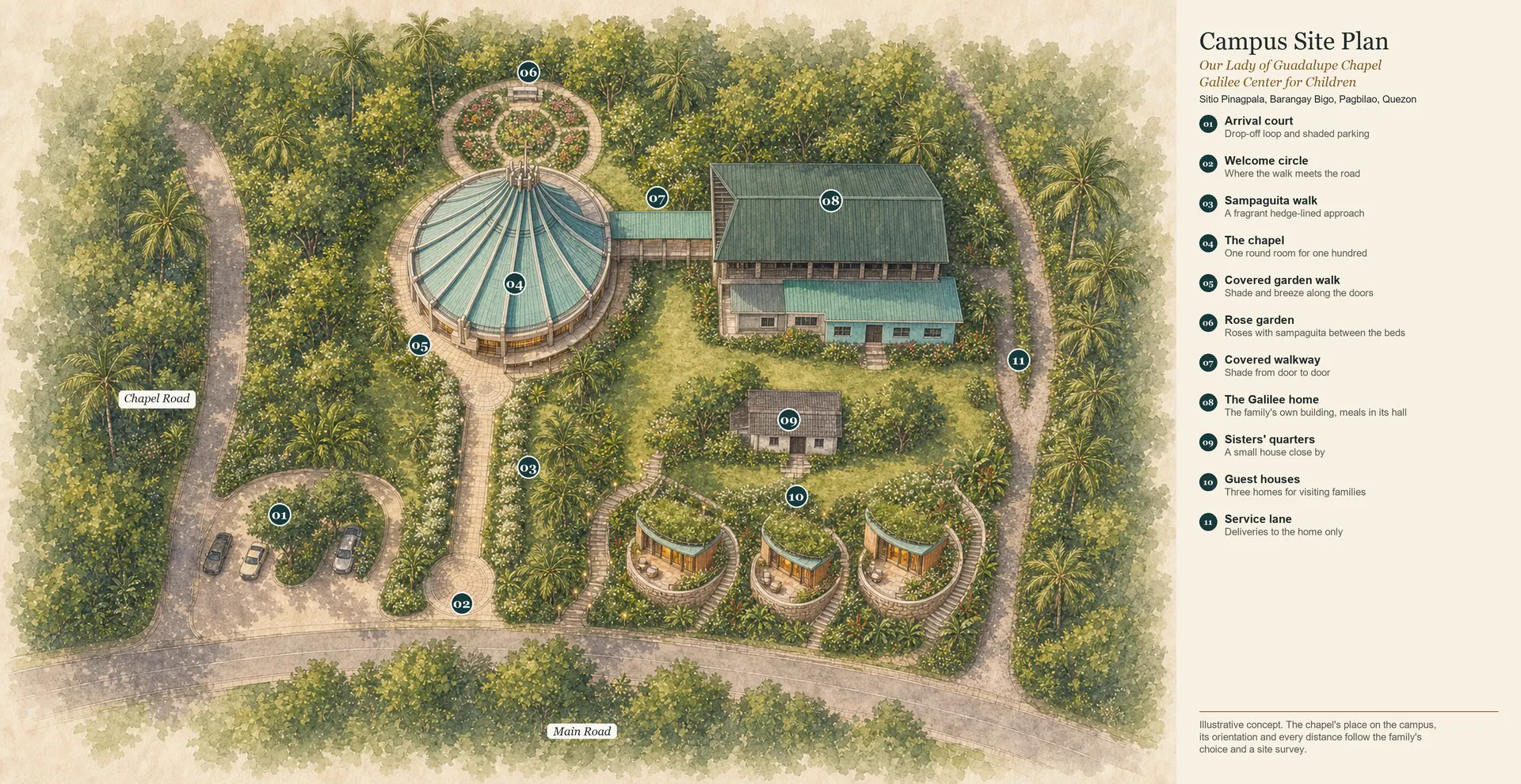
Eleven places, one welcome
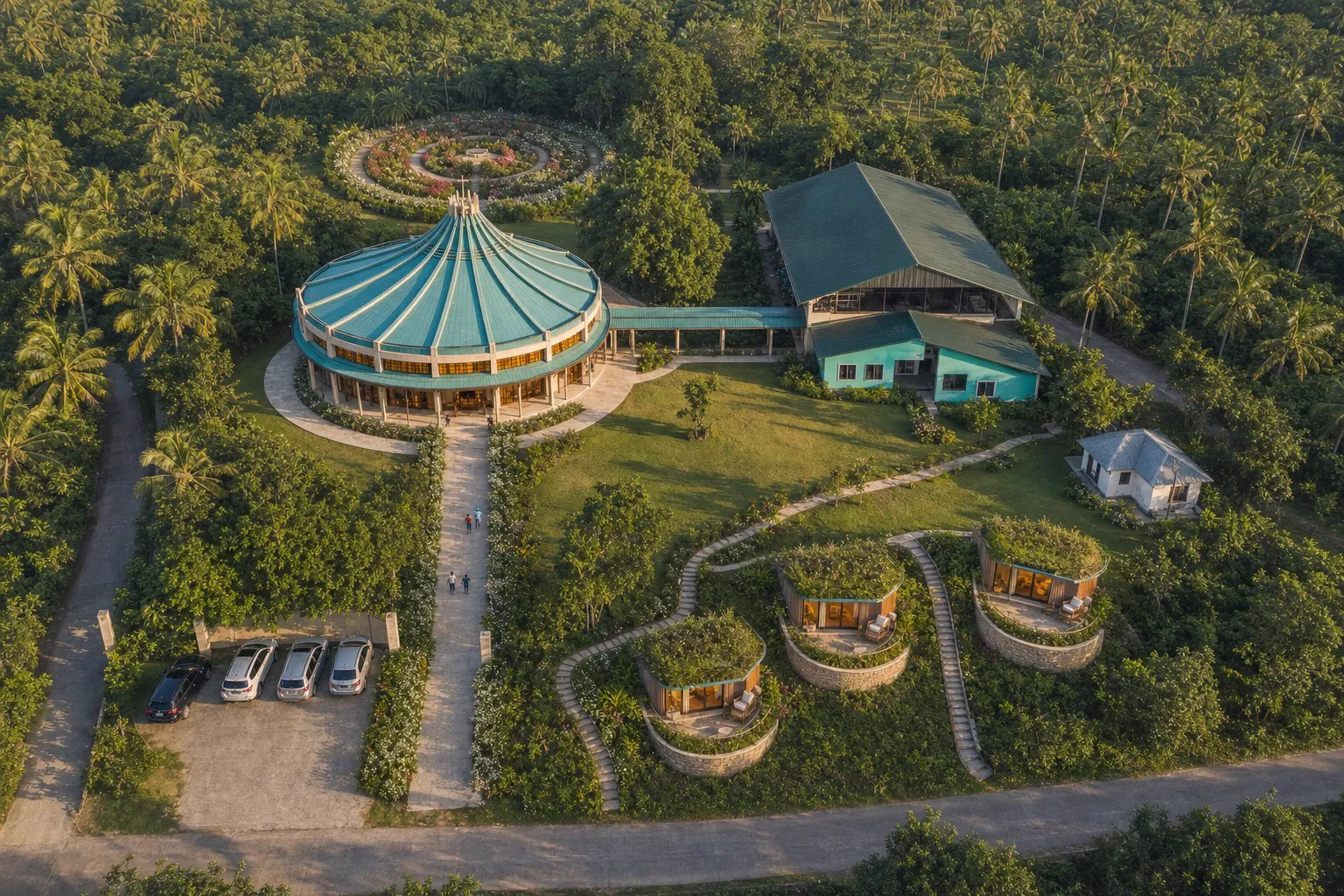
Visitors arrive from Chapel Road at a shaded court. From the welcome circle, a fragrant walk of sampaguita leads straight to the chapel doors. A covered garden walk hugs the chapel on both sides, and a rose garden waits behind it. A covered walkway leads to the Galilee home, the family’s own building, with the sisters’ quarters close by. Three guest houses step into the hillside below, and deliveries keep to their own lane.
- 01Arrival court · drop-off loop and shaded parking
- 07Covered walkway · shade from door to door
- 02Welcome circle · where the walk meets the road
- 08The Galilee home · the family’s own building, meals in its hall
- 03Sampaguita walk · a fragrant hedge-lined approach
- 09Sisters’ quarters · a small house close by
- 04The chapel · one round room for 100
- 10Guest houses · three homes for visiting families
- 05Covered garden walk · shade and breeze along the doors
- 11Service lane · deliveries to the home only
- 06Rose garden · roses with sampaguita between the beds

The shaded garden circle
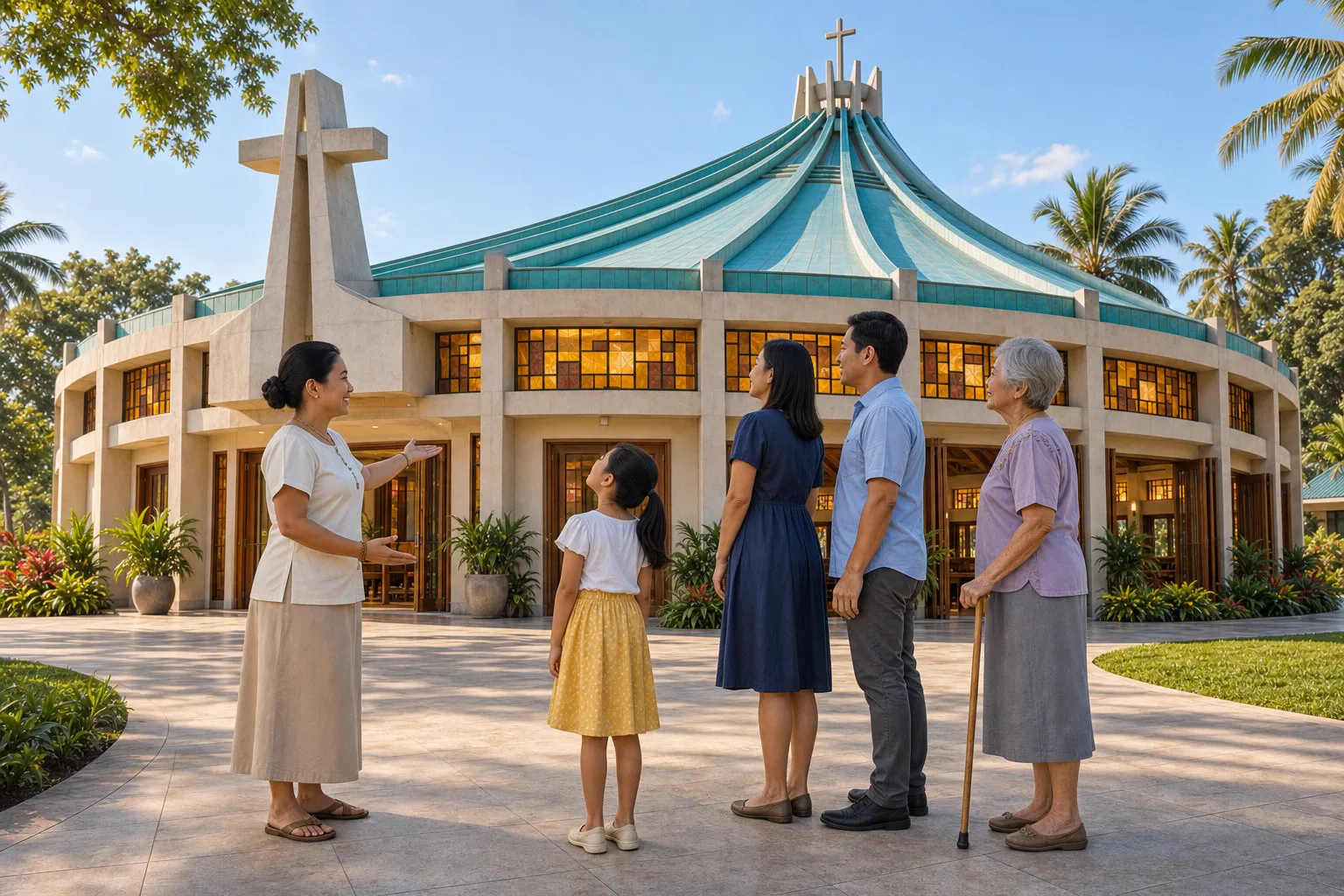
One round room, twenty-five meters across, under a single sweeping roof.
The family chose the shaded garden circle. Folding timber-and-glass doors open the whole room to the garden. A covered walk three meters deep follows the curve on both garden sides, so every doorway sits in cool shade.
High above, glass jalousies in the amber band let warm air out, and four ceiling fans keep a gentle breeze over the outer seats. Inside hangs the Solihiya at Narra chandelier, and the side windows glow with pale glass touched with color.
The chapel on the sheet
Before we set out, here is the chapel on the architect’s sheet.
One round room under a single roof, long at the front, short at the back, with the crown set over the sanctuary. Pale piers repeat around the curving wall, with amber glass glowing above them. Timber-framed doors open straight onto the garden.
Every note on this page is a promise about how the room will feel.
Entry to altar axis, two seating banks, side circulation, a continuous floor level, a garden at the threshold: the sheet carries the room’s own notes, from the ground floor to the rhythm of the bays.

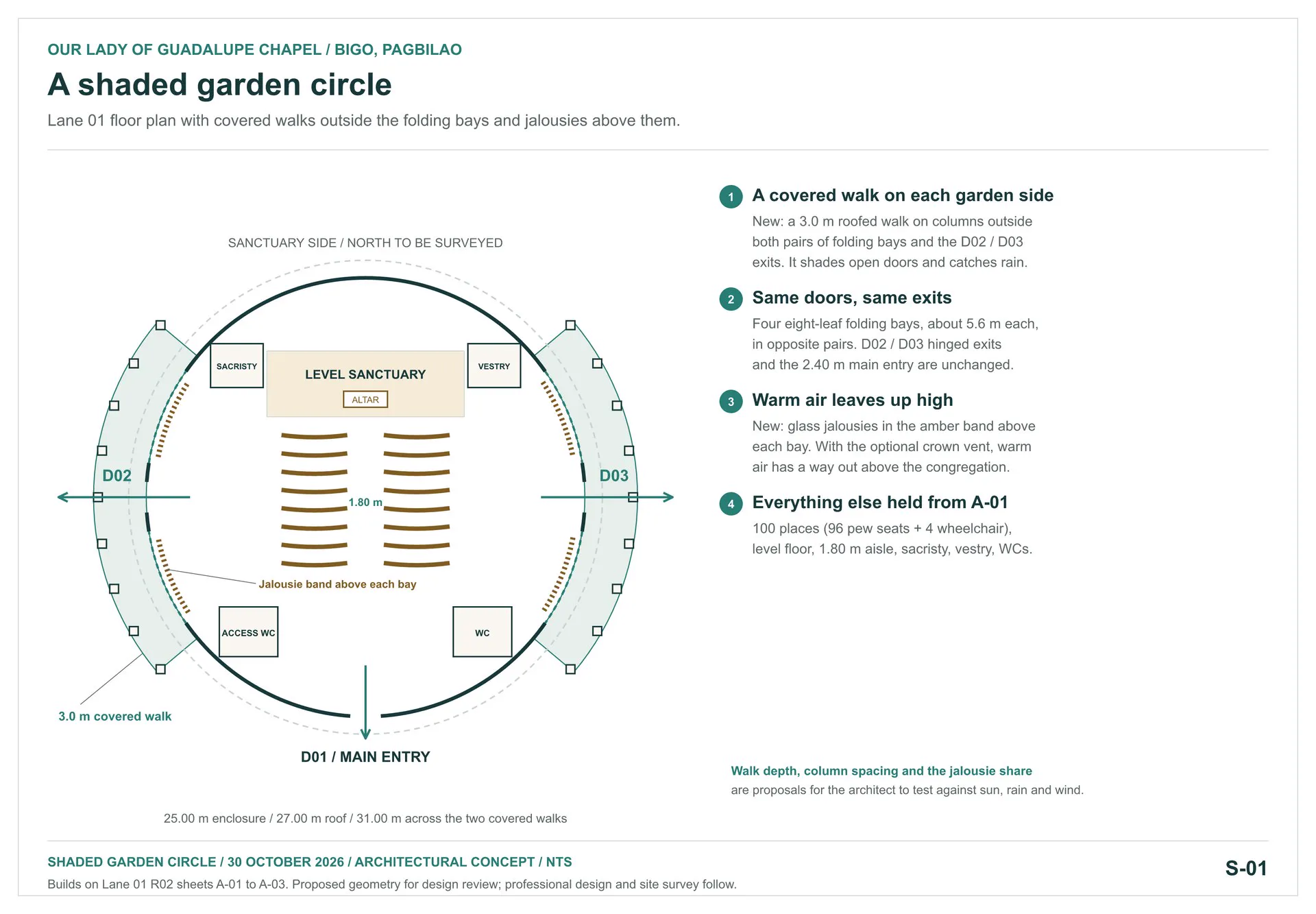
A room gathered in prayer
Arrival
It’s eight in the morning. Dew still clings to the leaves, and the air smells of jasmine. Our first stops lead from the village road, along the sampaguita walk, to the chapel doors.
Your visit begins here
The car door closes, and the first thing you notice is the quiet. Your guide steps forward with open hands. Behind her the chapel rises in ivory and turquoise, with a tall stone cross beside the entrance like a gentle welcome.
The youngest visitor tilts her head all the way back to find the crown at the very top of the roof. Maligayang pagdating. Welcome.
Who would you bring here first?
A fragrant welcome
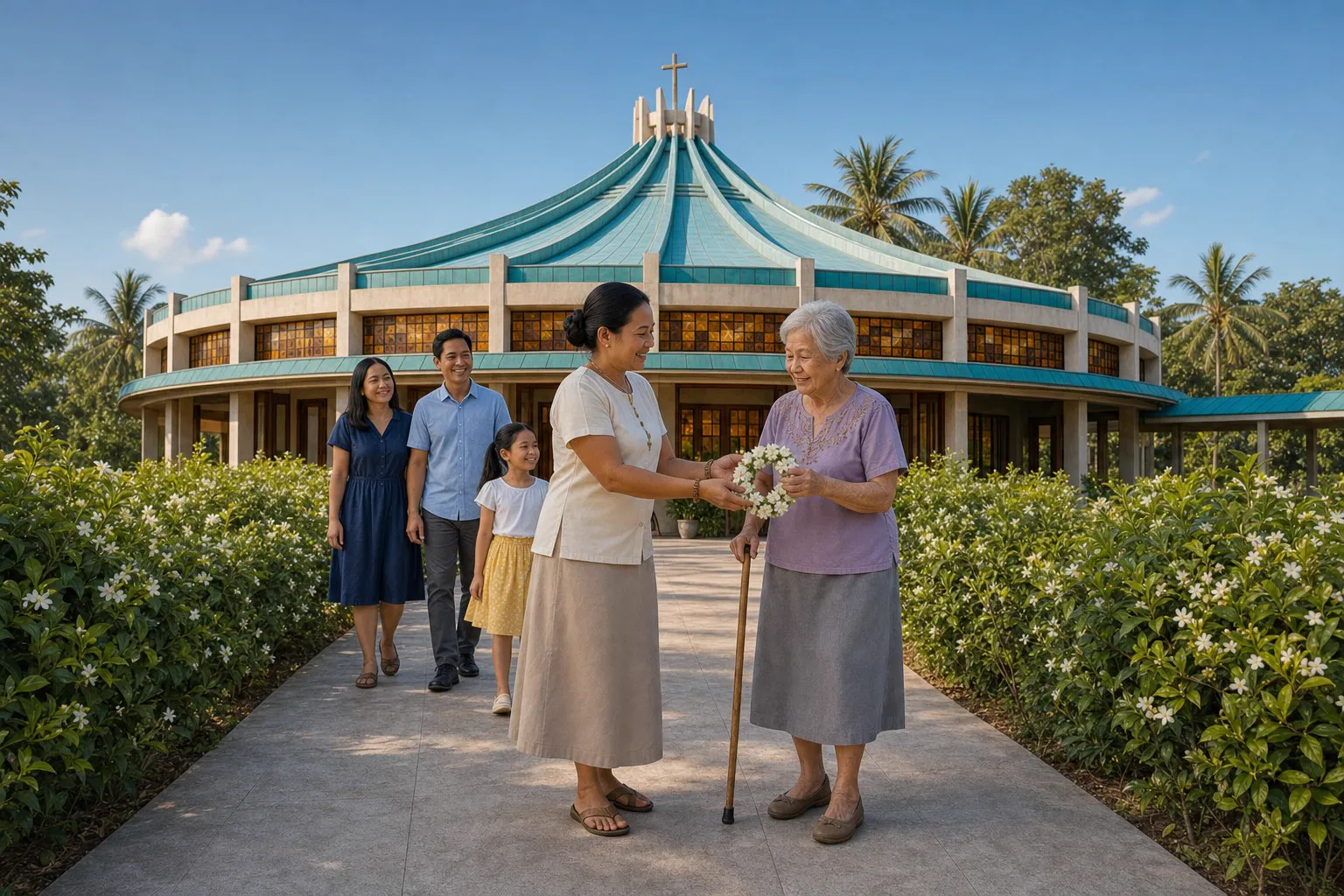
Breathe in. On both sides of the path, low hedges are covered in small white stars.
This is sampaguita, Jasminum sambac, named the national flower of the Philippines on 1 February 1934, together with the narra as the national tree. Filipinos have strung its flowers into garlands for generations, as gifts for the altar and for the saints.
Your guide places a fresh garland in Lola’s hands. Outside many Filipino churches, sellers offer garlands at the door; inside, families hang them on Our Lady’s image as a fragrant gift. Here, the garlands come from our own sampaguita walk.
The jasmine greets every visitor before the doors do, and on still evenings its perfume reaches the road.
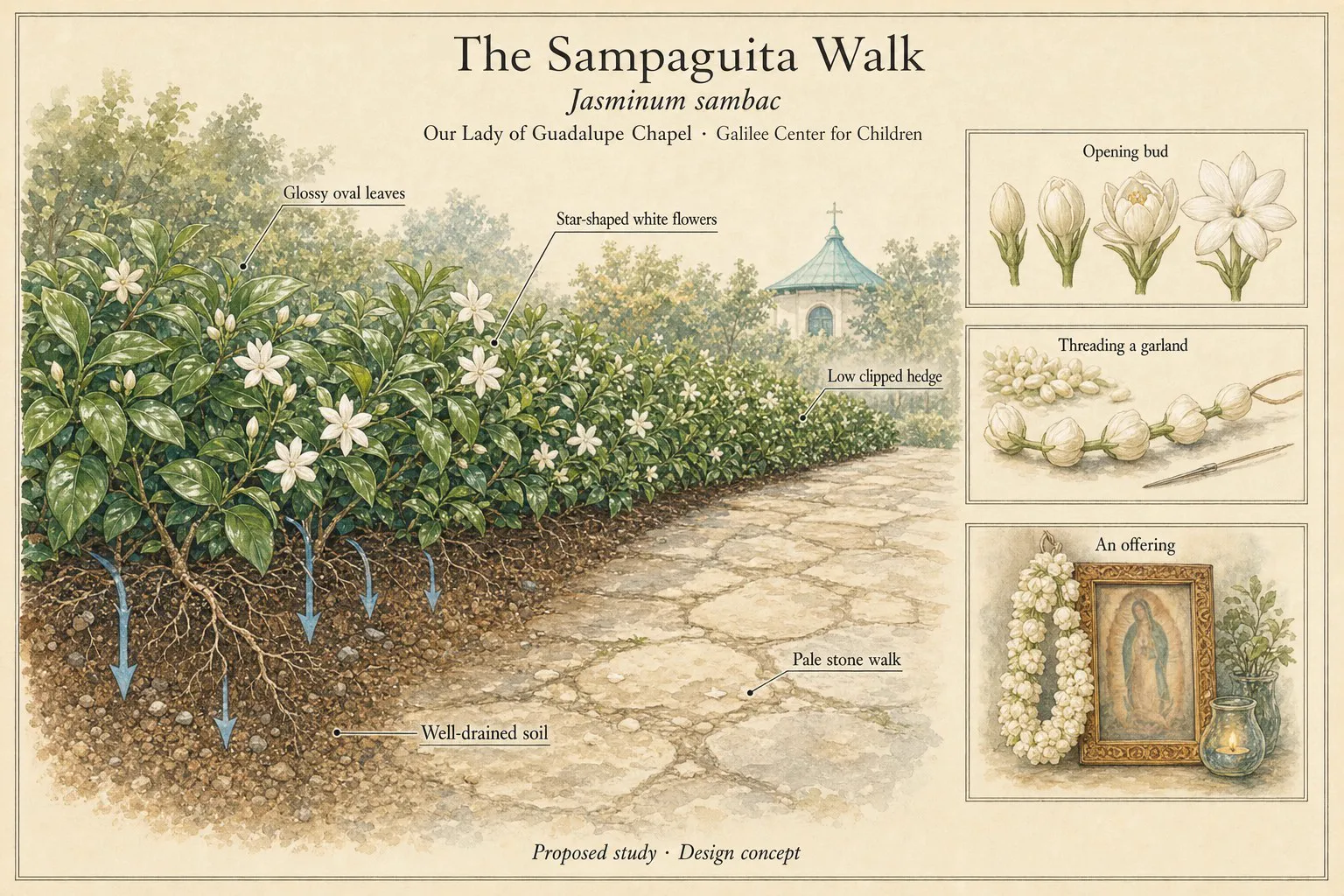
The sampaguita walk
The buds open in the evening and fill the air with perfume. Before dawn they are picked, threaded one by one onto a string and finished with a little ribbon.
A low clipped hedge in well-drained soil keeps the flowers at hand height, so children and grandparents alike can smell them as they pass.
Guests learn to thread a simple garland at the walk, a small gift they can carry to Our Lady.
A round room, like Tepeyac
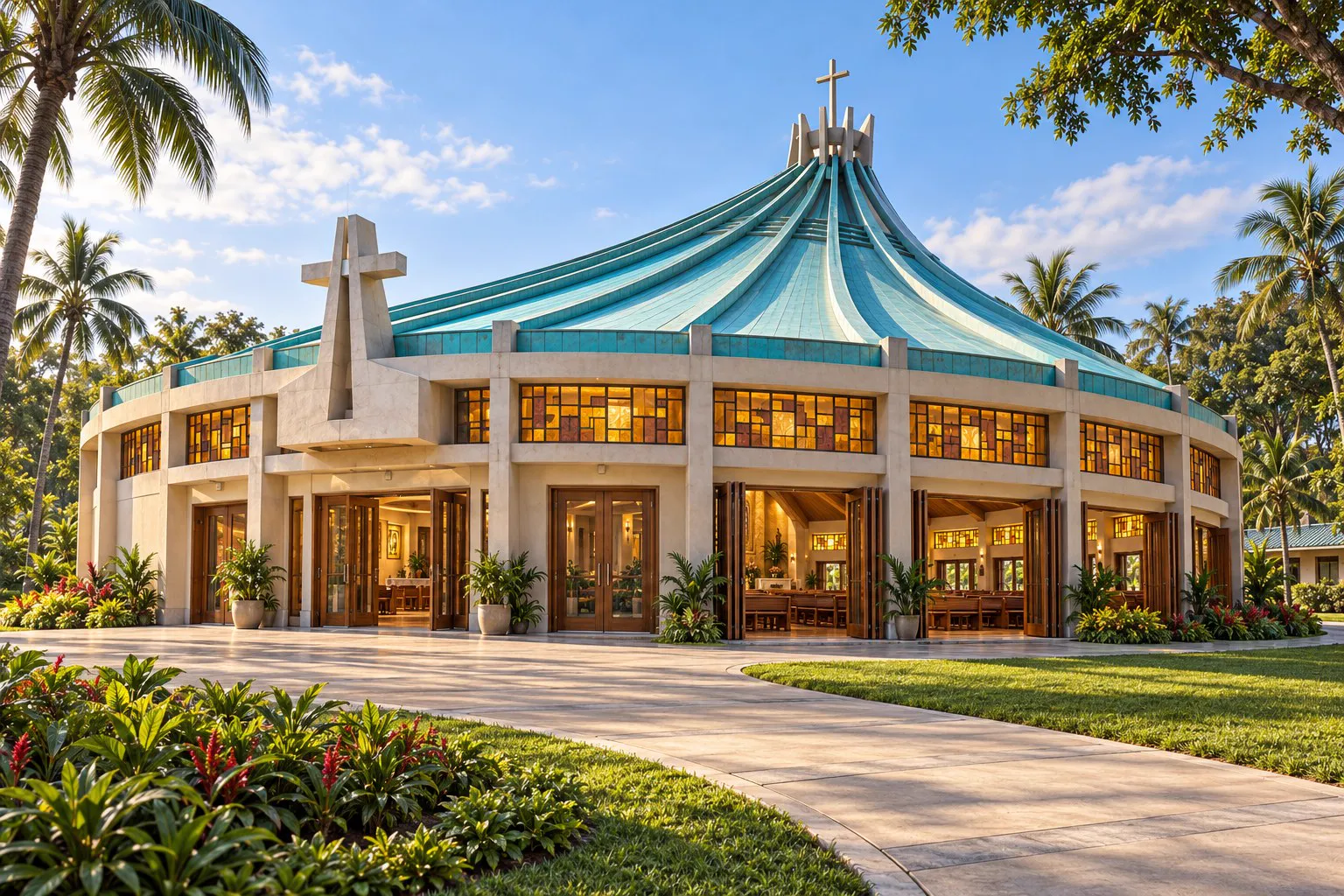
Everyone close to the altar
The chapel is round, so everyone gathers close to the altar. It takes its spirit from the Basilica of Our Lady of Guadalupe in Mexico City, a round room opened in 1976 and designed by a team led by Pedro Ramírez Vázquez so that all of its roughly ten thousand worshippers can see her image. Some twenty million pilgrims visit each year.
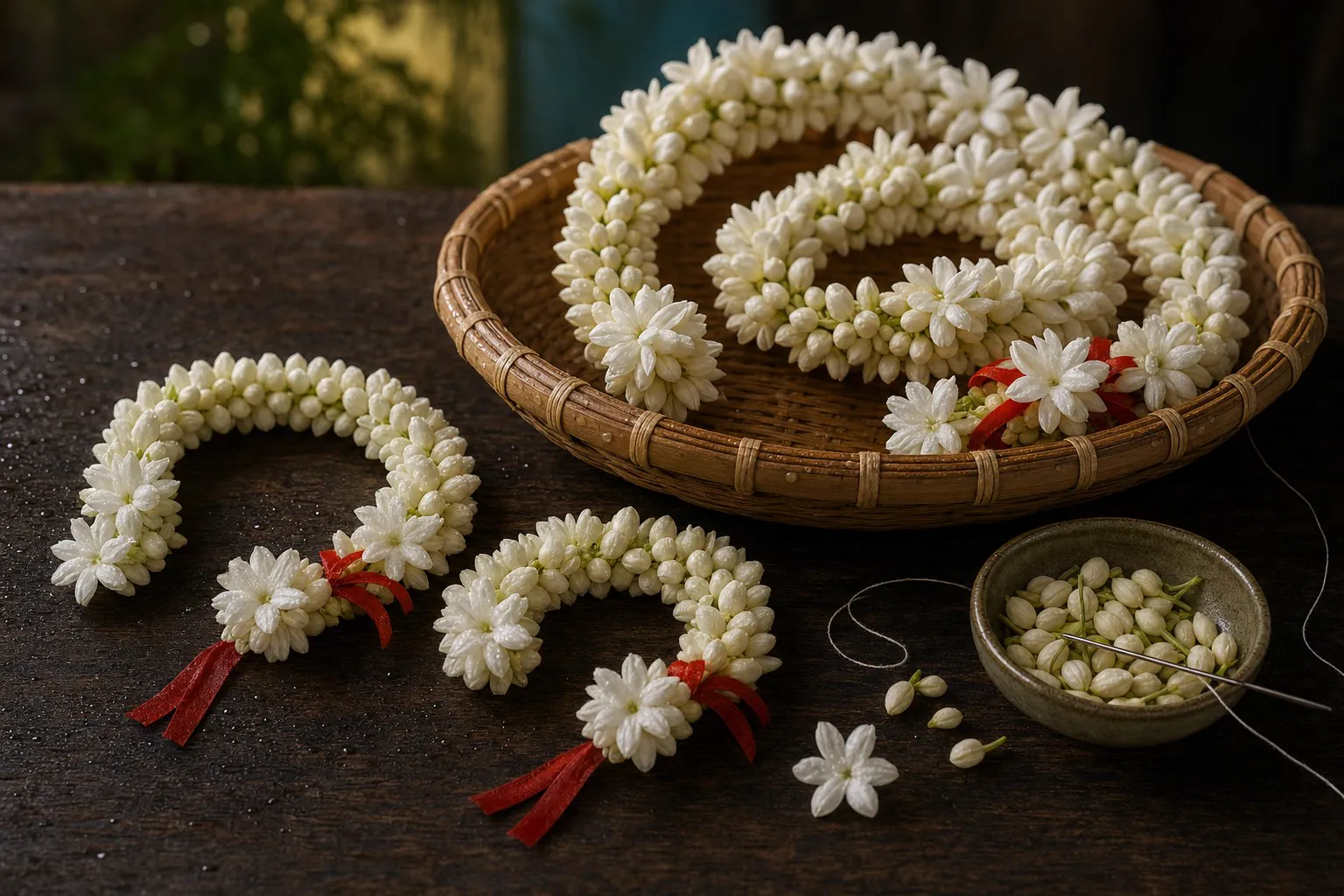
Garlands from the walk
Fresh garlands of white jasmine, each finished with a short red ribbon, wait in a cane basket by the door. Visitors carry one inside to hang beside Our Lady, and the room fills with their perfume through the morning.
Step Inside
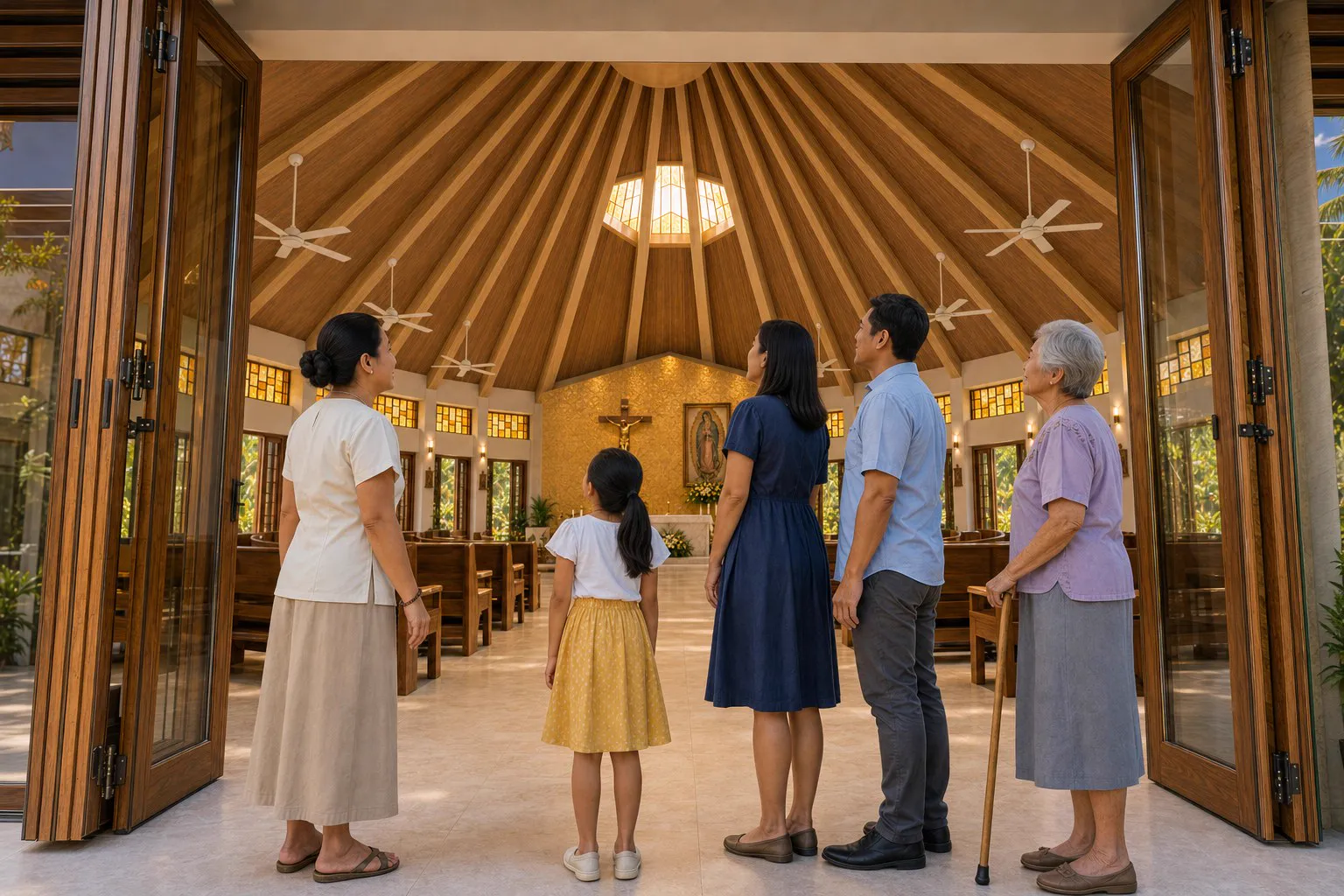
Step through the open doors, out of the bright morning and into the cool of the room. Now look up: warm timber ribs rise from every side and meet in a crown of light above the sanctuary.
A place together
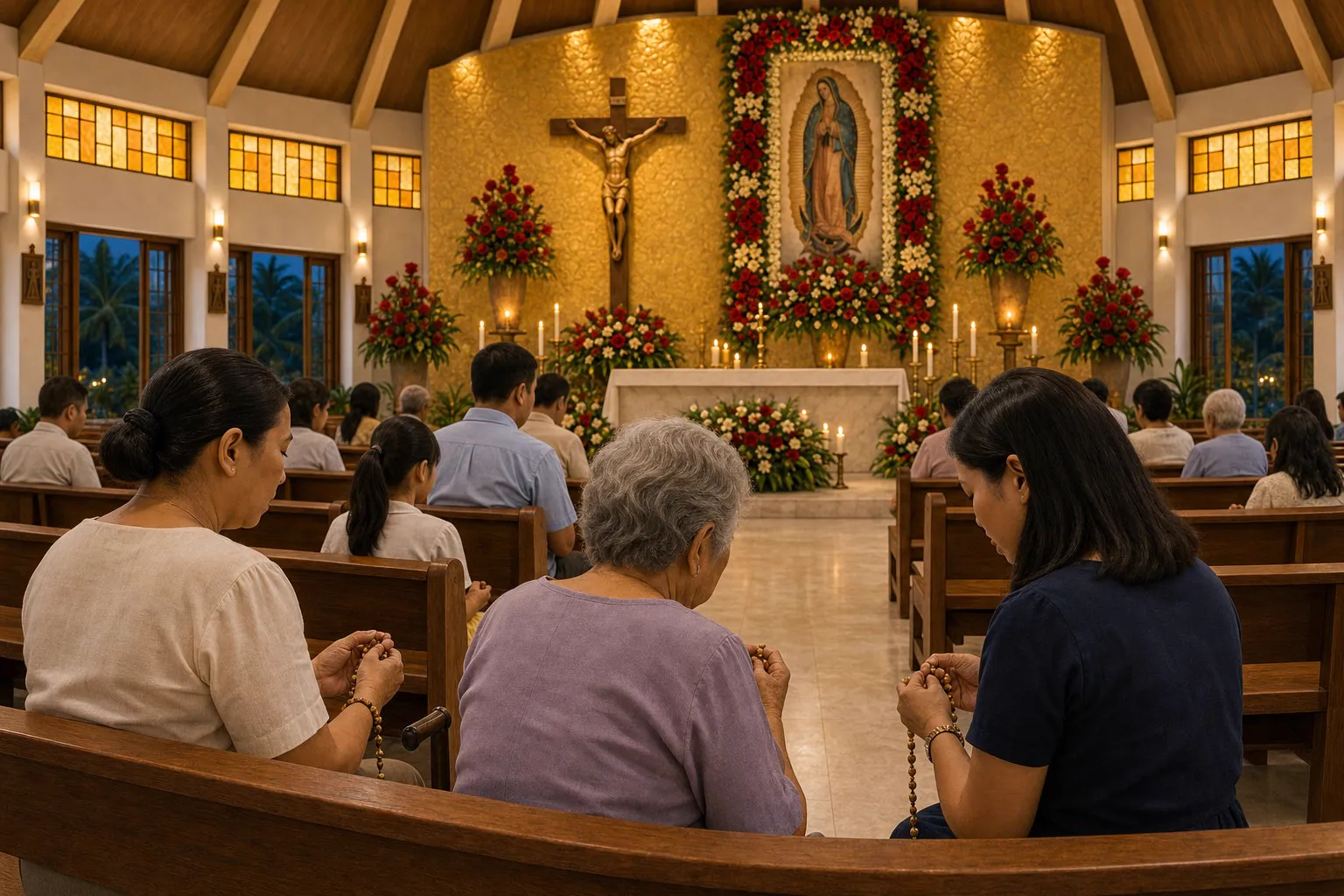
Curved rows of warm wooden seats face one level sanctuary, so every face turns toward the altar.
A band of amber glass circles the room, and the morning sun turns it to honey. The high roof lets warm air rise away from people, and slow ivory fans keep the breeze moving across the room.
There are one hundred places in all, including four wheelchair places, each with a companion seat right beside it. Families choose front or rear places, and a level route leads from arrival to worship. Everyone sits together, close to the altar.
Every celebration welcomes the full, active participation of every person, whatever their age or ability.
Our Lady at the center
On the golden wall behind the altar, she looks down with lowered eyes and joined hands.
In December 1531, on the hill of Tepeyac near what is now Mexico City, the Virgin Mary appeared to Juan Diego, a humble Indigenous man. On 12 December she sent him to gather roses blooming in the winter cold.
When he opened his tilma before Bishop Juan de Zumárraga, the roses tumbled out, and her image was there on the cloth. That tilma still hangs in her basilica today.
Every piece has its purpose

Stars, sun and moon
She wears a rose-colored gown and a blue-green mantle scattered with stars. She stands before the rays of the sun, with the moon beneath her feet, held up by an angel. Her lowered eyes and joined hands, and the dark sash that told the Aztec people she was with child, are often explained as her quiet way of saying that she comes carrying Christ.
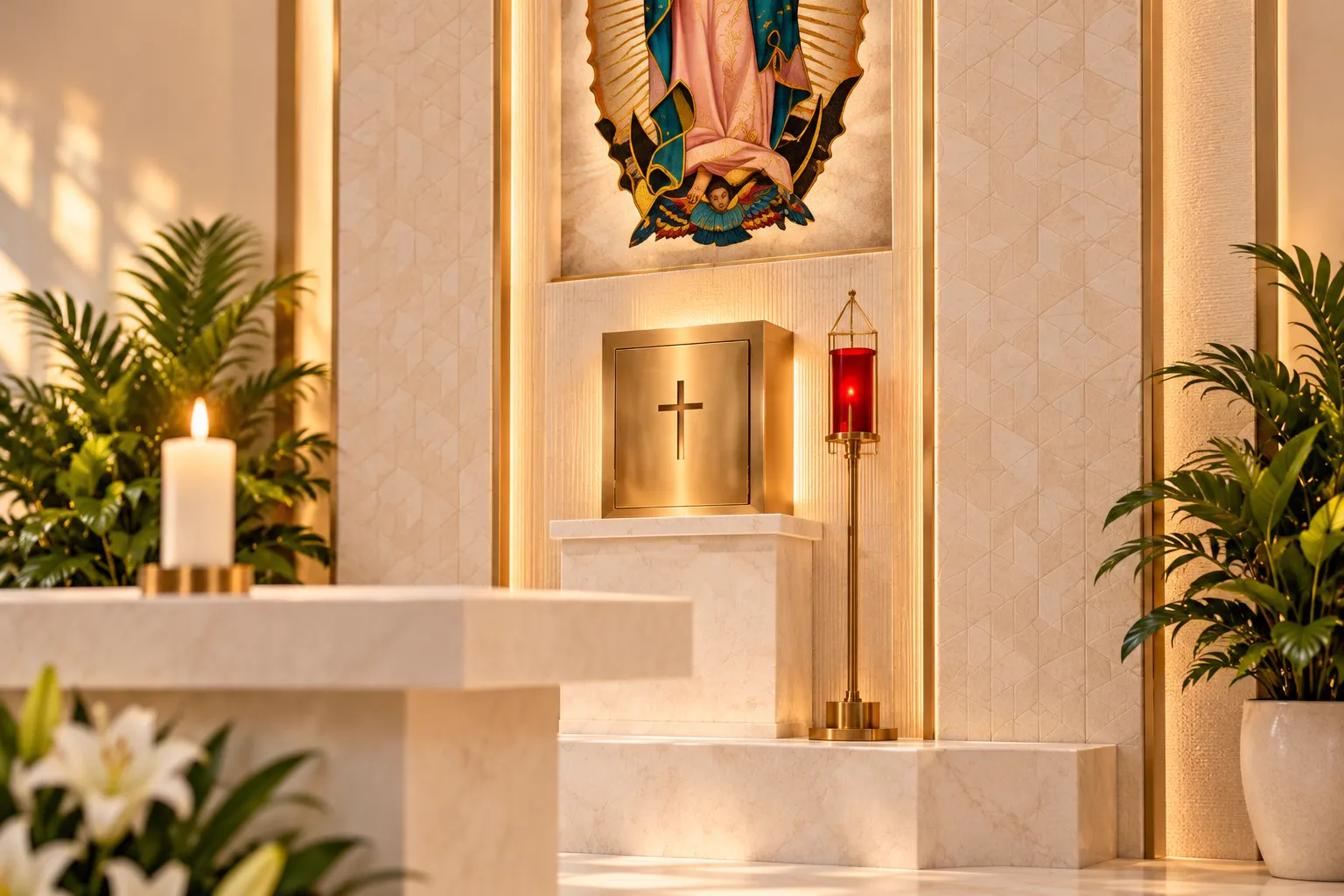
Table, word and presence
The altar is the Lord’s table, where the Mass is offered; the ambo is where God’s word is proclaimed; the chair is where the priest leads the prayer. The tabernacle, set apart from the altar with its glowing red lamp, is where the Blessed Sacrament is kept.
A Filipino Lady, too
Our Lady of Guadalupe has a special place in Filipino hearts.
In 1935, Pope Pius XI named her the Celestial Patroness of the Philippines. In 2002 the Filipino bishops honored her again as the Pro-Life Patroness of the Philippines, and Saint John Paul II called her the Patroness of all America.
Her feast is 12 December, kept in the Philippines as an obligatory memorial. Juan Diego, declared a saint in Mexico City on 31 July 2002, is remembered on 9 December, the day she first appeared to him.
In Pagsanjan, Laguna, a Mexican image of Our Lady of Guadalupe has been honored since 1688, and the church there became a diocesan shrine in 2012.

Light and Glass
By mid-morning the sun climbs higher, and the room begins to glow. Four story windows, a band of amber glass and pale panes touched with color carry the light across the floor.
Light you can hold
Low in the wall, a painted window glows with sunlight: Saint Juan Diego, carrying roses in the fold of his cloak.
Our youngest visitor holds out her hands, and pools of rose, amber and blue settle in her palms. Her mother kneels beside her and points to the roses in the glass, the same winter roses Juan Diego carried to the bishop.
Each window is made the traditional way. Glass paint made from powdered glass and metal oxides is fired in a kiln until it fuses to the pane, and the pieces are set in soft lead came and sealed.
Manila has its own stained-glass lineage: Matthias Kraut opened his studio in 1912, and Kraut Art Glass windows still light Santo Domingo Church and Baclaran.

Christ the Good Shepherd
He holds a lamb. “I am the good shepherd,” a promise of care that fits a place built for children.
Saint Juan Diego
He carries winter roses in his cloak, the sign Our Lady sent to the bishop in 1531.
Saint Joseph and Jesus
The carpenter of Nazareth guides the young Jesus at the workbench, patron of fathers and workers.
Saint Francis with birds
Tradition tells how Francis stopped on an Umbrian road to preach to the birds; he was the friend of every living thing.
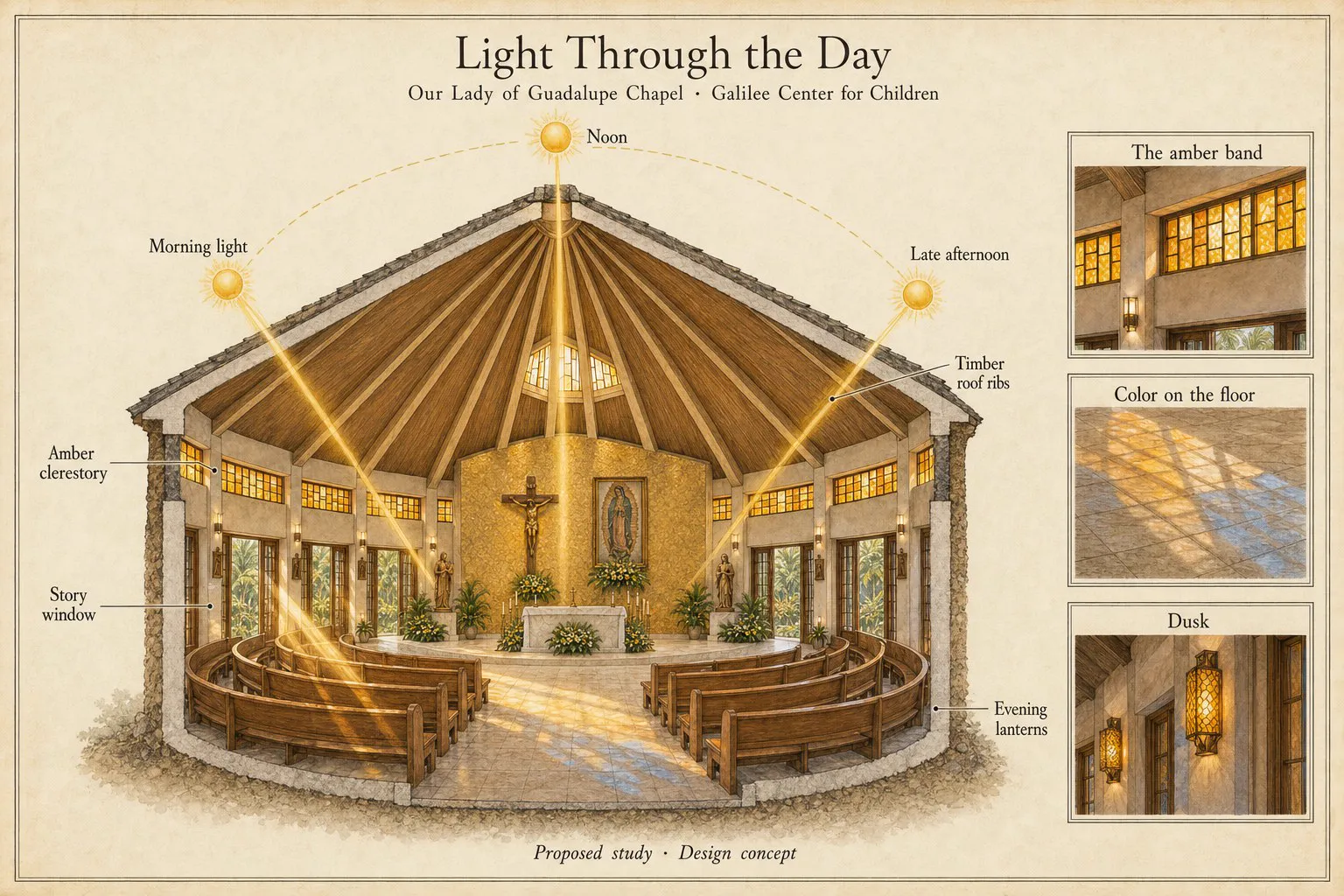
Light through the day
Through the day, sunlight carries the windows’ colors across the floor and the ivory piers, so the room slowly changes as the hours pass.
Morning light enters low through the amber clerestory, noon falls from the crown, and late afternoon lays rose and blue across the curved seats. At dusk, the Solihiya at Narra chandelier and its lanterns take over.
The side windows use pale glass with color accents: soft, light-filled panes touched with small jewels of blue, amber and violet that lead the eye gently back to Our Lady.
A candle for someone
A flame that keeps praying
Near the sanctuary, a stand of small amber candles flickers, and Lola lights one with a long taper. It is an old Catholic custom: the flame stands for a prayer, a thank-you or a loved one’s name, and it keeps glowing after you go.
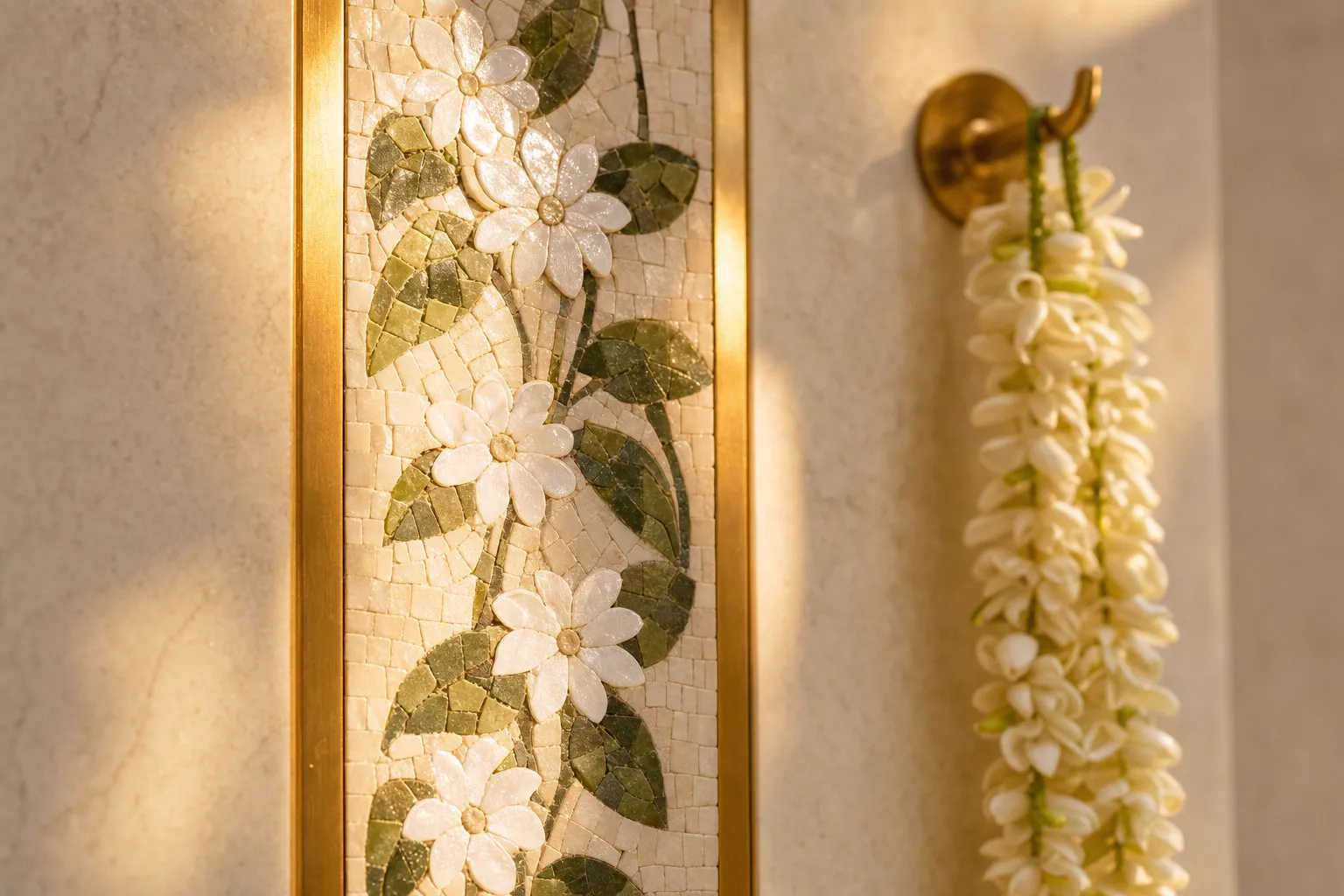
A garland made to last
Beside the candles, a narrow ribbon of mosaic sampaguita climbs the ivory sanctuary wall in pearly tesserae, edged in brushed gold. Fresh garlands from the walk hang beside it, the living flower and its lasting image side by side.
Walking the Way of the Cross
A prayer you walk
Fourteen carved Stations hang around the curving wall between the windows. They let us walk with Jesus to Calvary, the way pilgrims once walked the streets of Jerusalem, a prayer the Franciscans carried to the world and the Church set at fourteen stations in 1731.
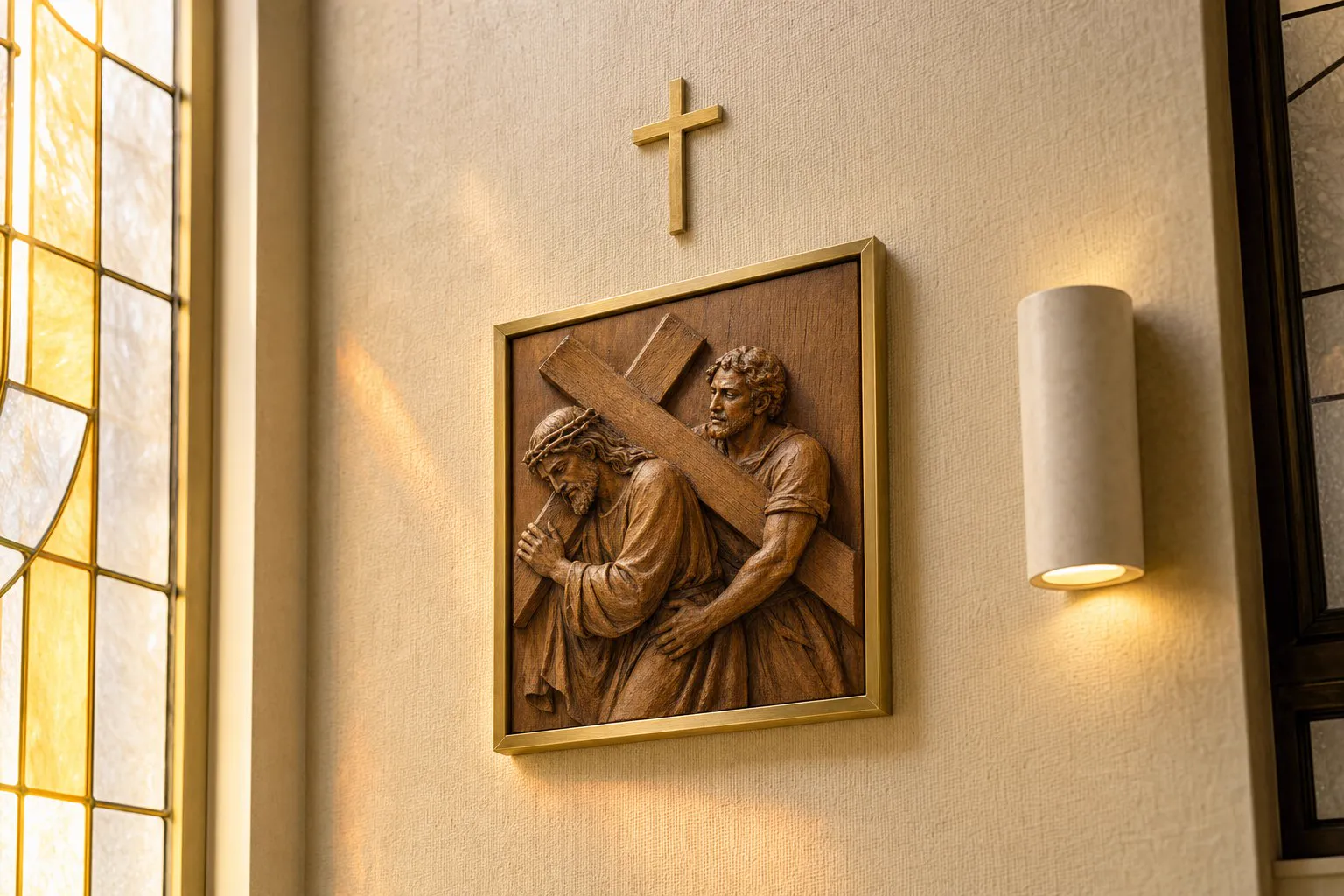
Simon helps carry the cross
Each panel is warm carved wood in a slim brushed-gold frame, with a small gold cross above. On Fridays and all through Lent, visitors move slowly from one to the next, in the soft light from the garden doors.
Shade, breeze and rain
A tropical shower rolls in. Under the covered walk, it is dry and cool.
Lola and our guide sit on the timber bench and share a laugh, while the youngest catches drips from the gutter. The rain runs from the gutters into the garden, and the leaves turn glossy.
The chapel borrows old tropical wisdom: a deep roof and a covered walk shade the walls, while tall jalousies and folding doors let the breeze cross the room.
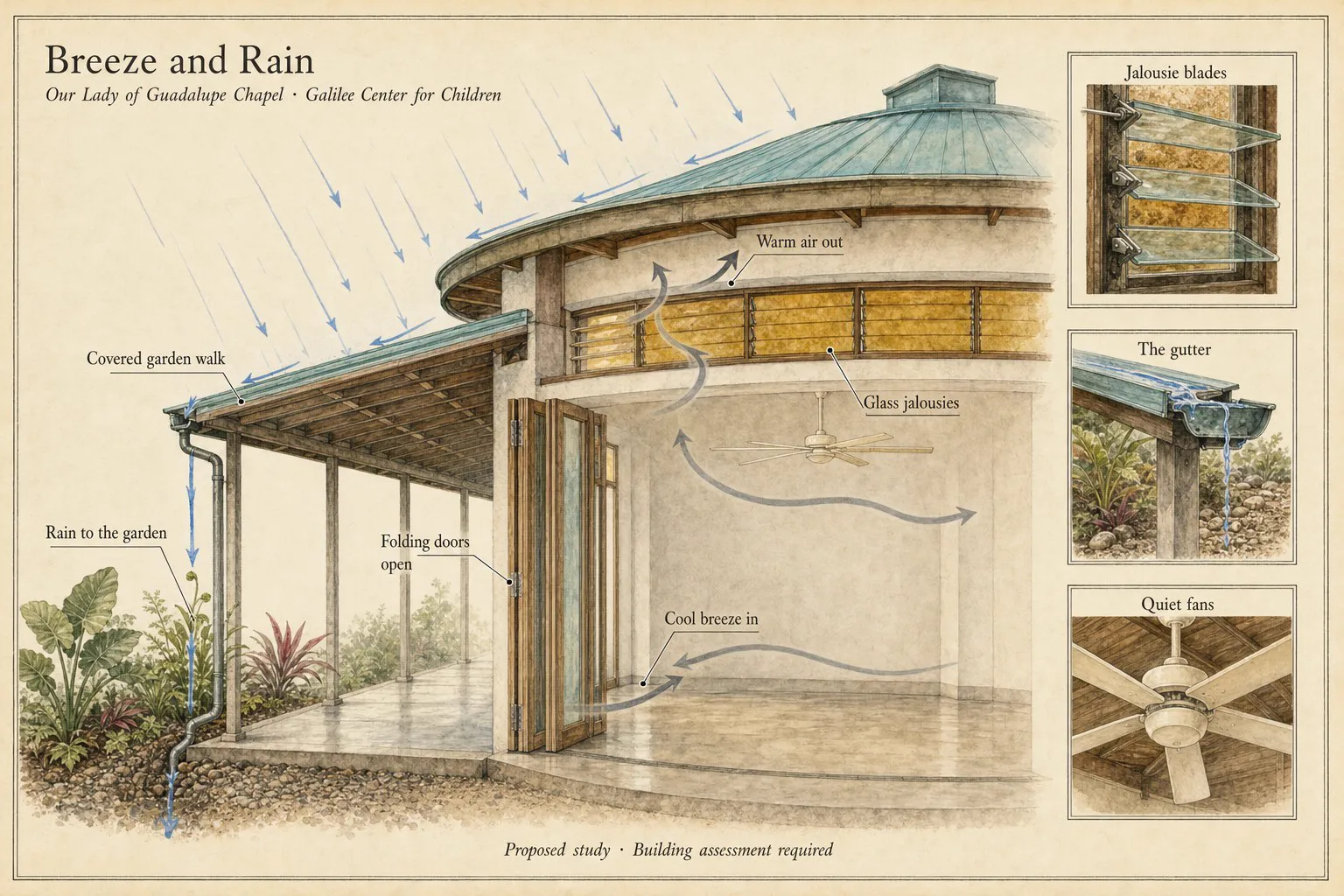
Breeze and rain
Blue arrows follow the rain: from the main roof and the covered-walk roof into the gutters and down to a planted garden edge.
Grey arrows follow the air: a cool breeze enters under the covered walk through the open folding doors, crosses the room beneath the fans, and rises out through the open jalousie blades high in the amber band.
The slatted louvre windows spread through Florida, Hawaii and the Philippines in the mid-twentieth century. They tilt open across almost the whole window, so the breeze moves through the whole room.
A room that breathes
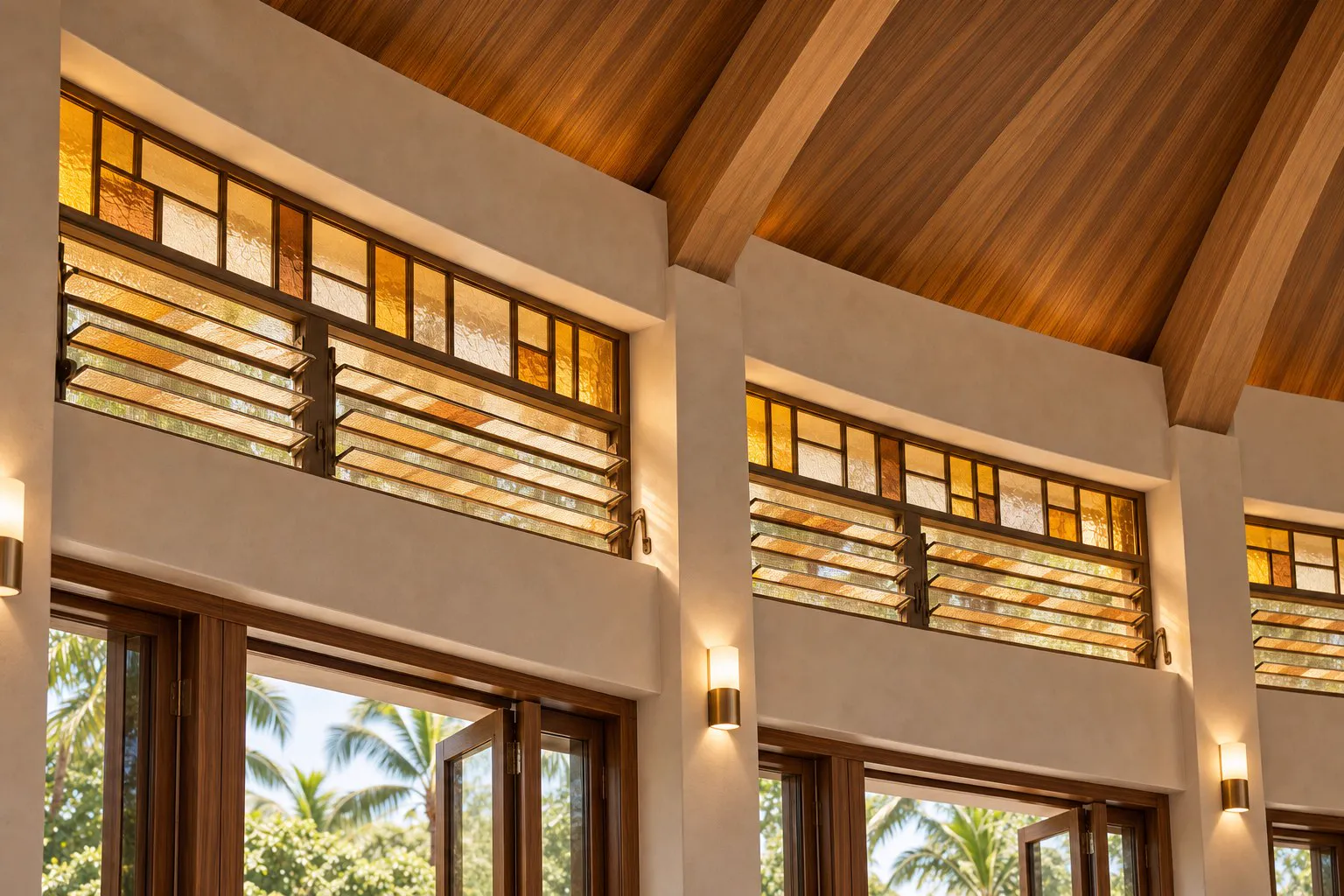
Jalousies, tilted open
The lower half of the amber band above each bay is made of glass jalousies, matching the geometric pattern and bronze frames of the glass around them, so warm air slips out high above the congregation.
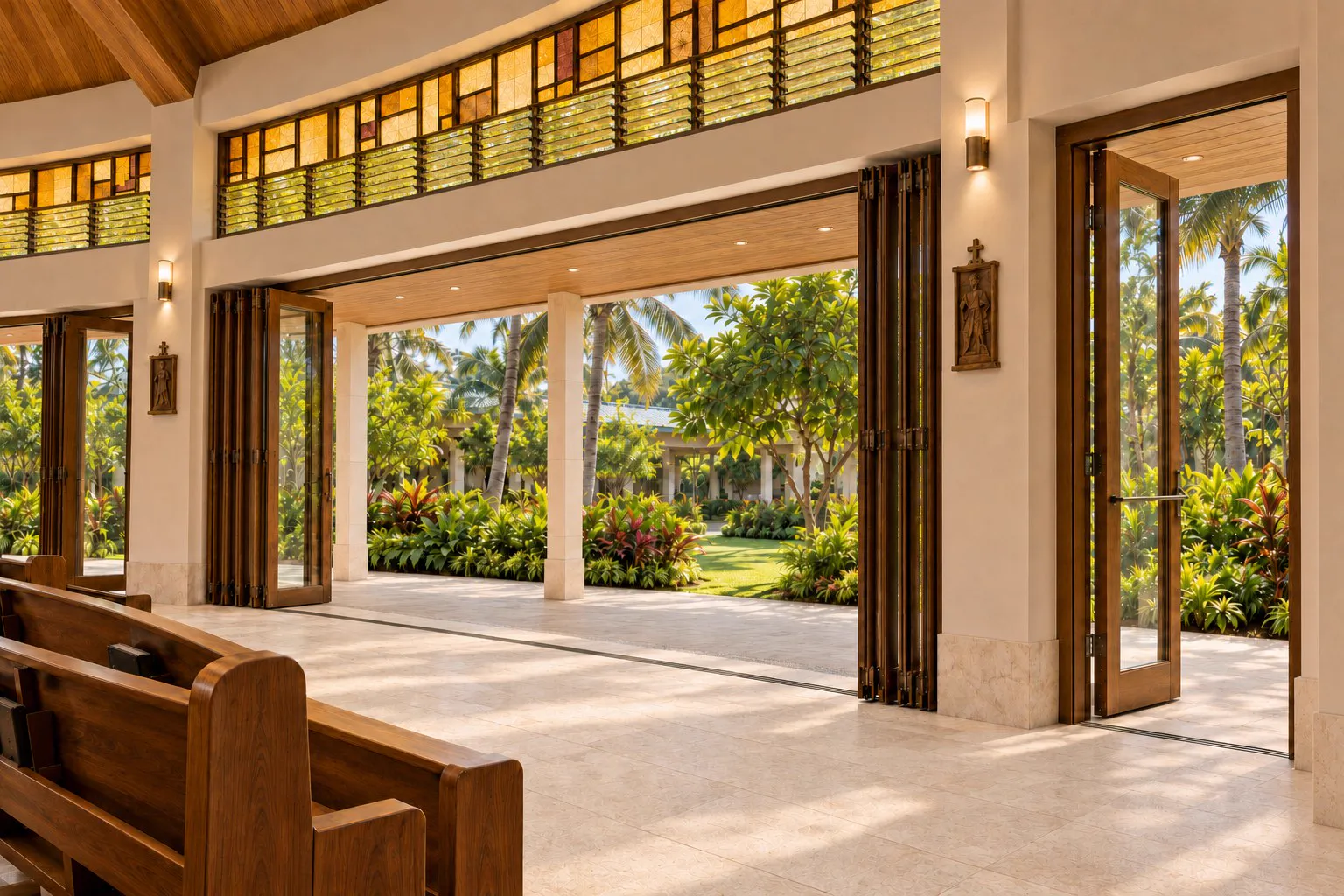
Shaded and bright
With the folding doors stacked open, the room flows out under the covered walk to the garden. The paving just beyond the threshold sits in shade, and the sunlit lawn glows beyond it.
Roses behind the chapel
The shower passes, and we step out through the back doors into the rose garden.
In a circle behind the chapel, roses bloom in soft pink, deep red and cream, with sampaguita planted between the beds. Lola bends to a pink rose still wet with rain.
Roses belong to this chapel. Juan Diego carried roses in his cloak, and the rosary takes its name from a garden of roses. In her Litany, Mary is called the Mystical Rose.
The Nican Mopohua remembers the flowers of Tepeyac “like precious pearls, as if filled with the dew of the night.”
Roses and jasmine together
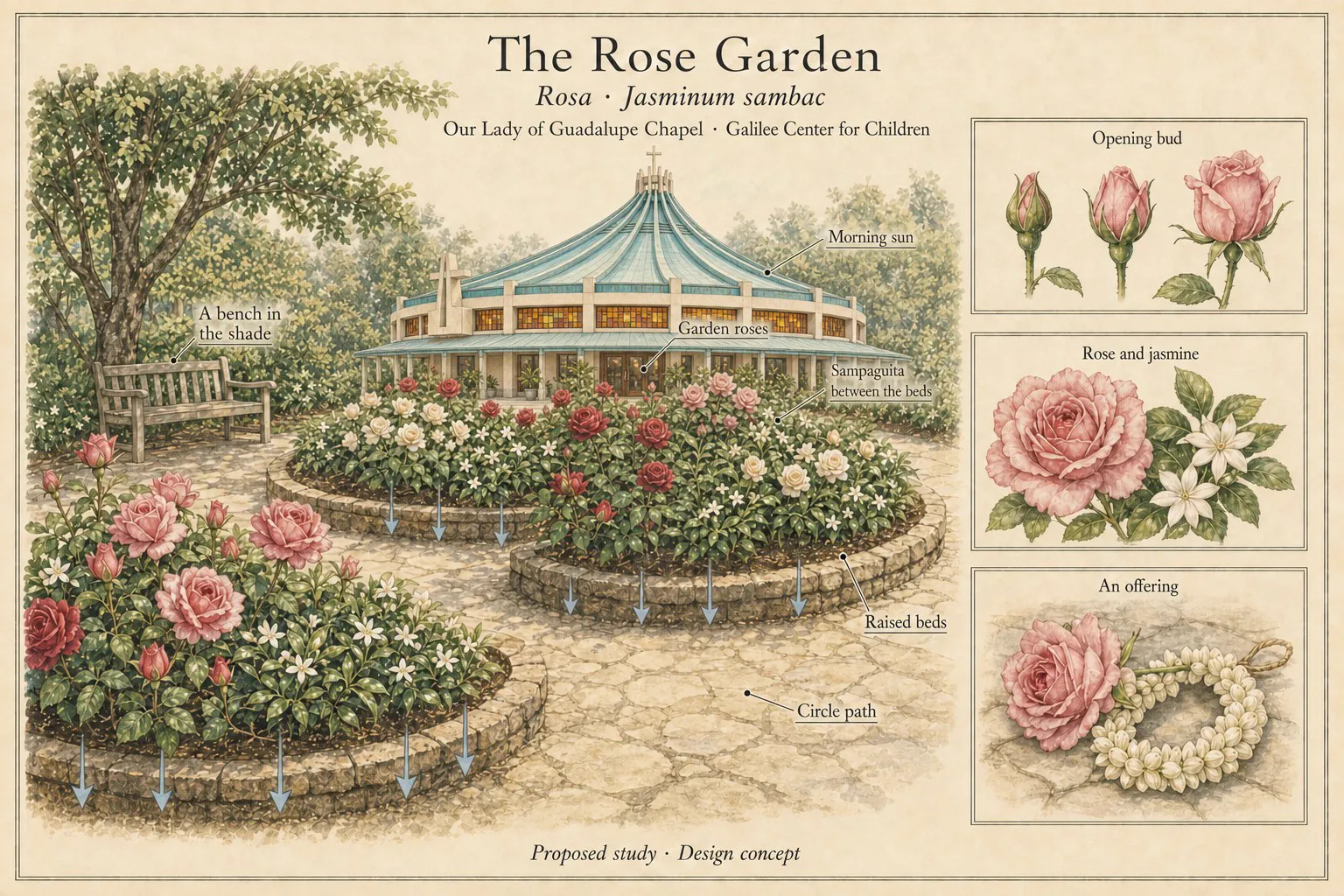
A study of the rose garden
The roses like morning sun and raised beds that drain after rain, with sampaguita in the spaces between. On Our Lady’s feast, roses from these beds go to the altar, and a shaded bench waits here for a quiet rosary.
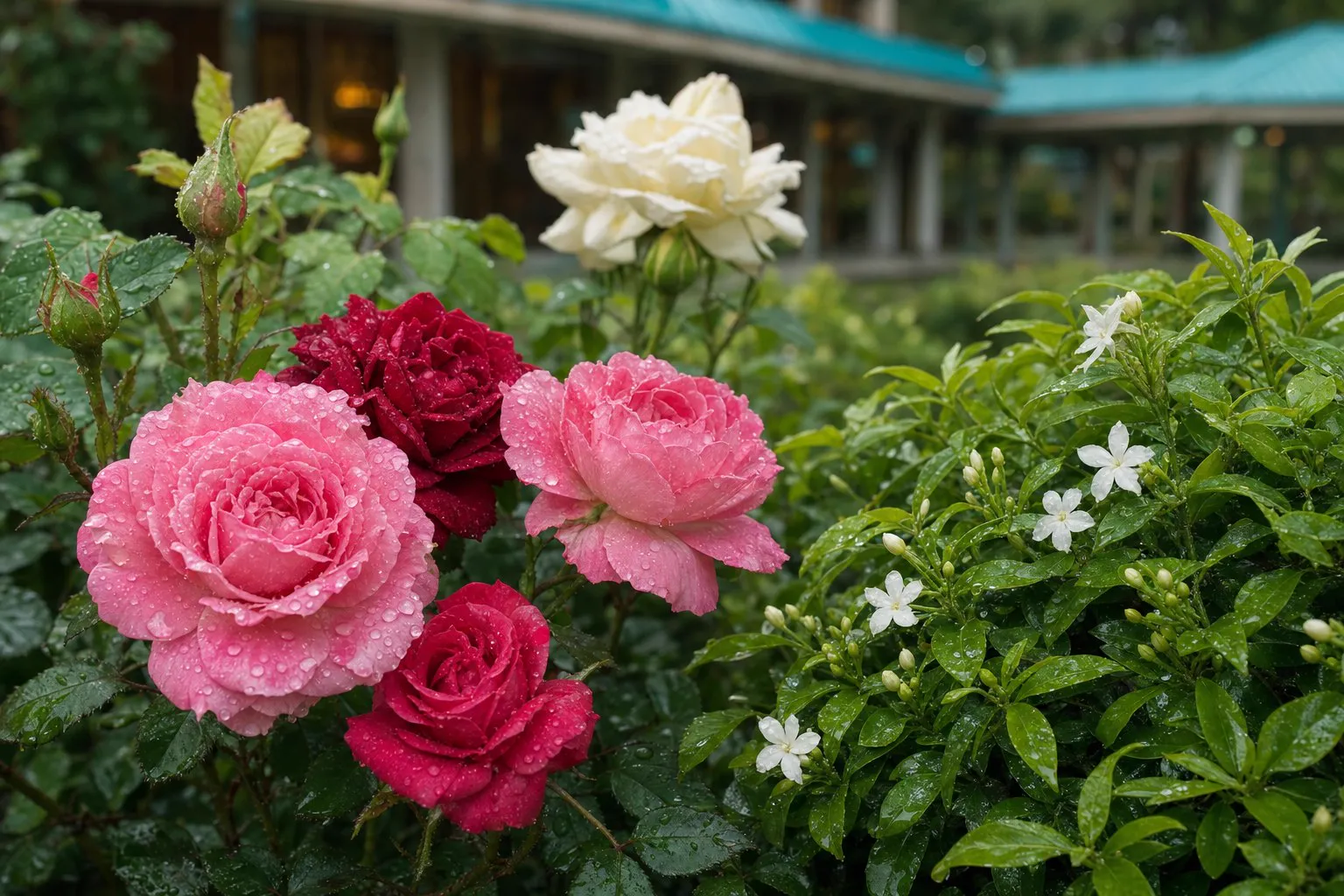
Roses and sampaguita after rain
Roses give their perfume in the early morning, and again as the evening cools. Sampaguita opens at dusk. So the garden greets you with roses at first light and with jasmine at lantern time.

The Galilee Home
It’s noon. Follow the covered walkway from the chapel to the Galilee home. You can already hear the laughter.
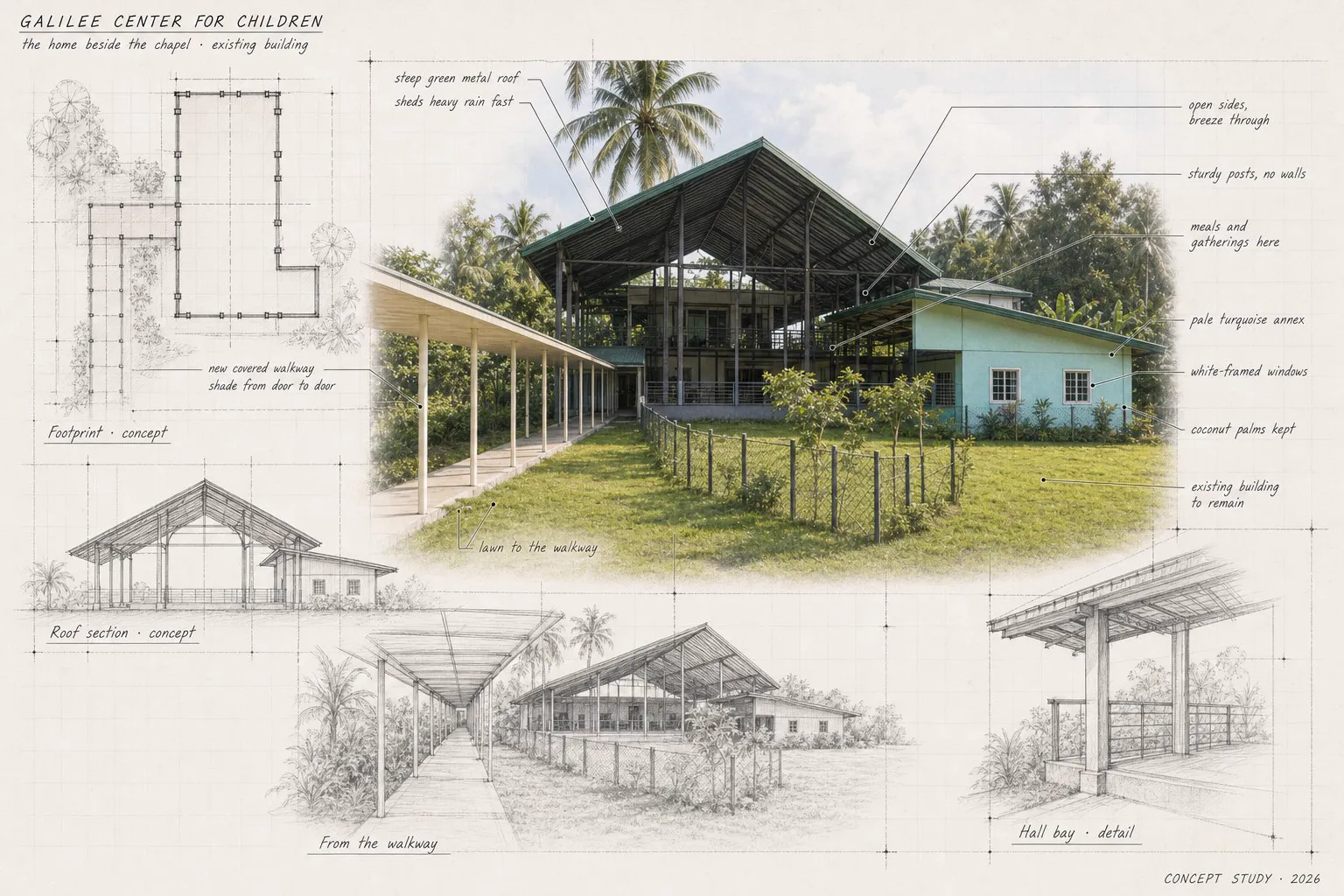
The home beside the chapel
This is the building the family already knows, the heart of the Galilee home. A steep green roof rises over an open hall on sturdy posts, so the breeze moves through and the rain runs off fast.
Beside it stands the pale turquoise annex with its white-framed windows. The new covered walkway joins the chapel to the home, door to door, in shade all the way.
A few steps on, a small house holds the sisters’ quarters, so Sister Diana and Sister Letty are always close by.
The PAGASA station at Tayabas, next door, averages 3,055.8 mm of rain a year, wettest from October to December. A roofed walk earns its keep.
Salu-salo after the binyag
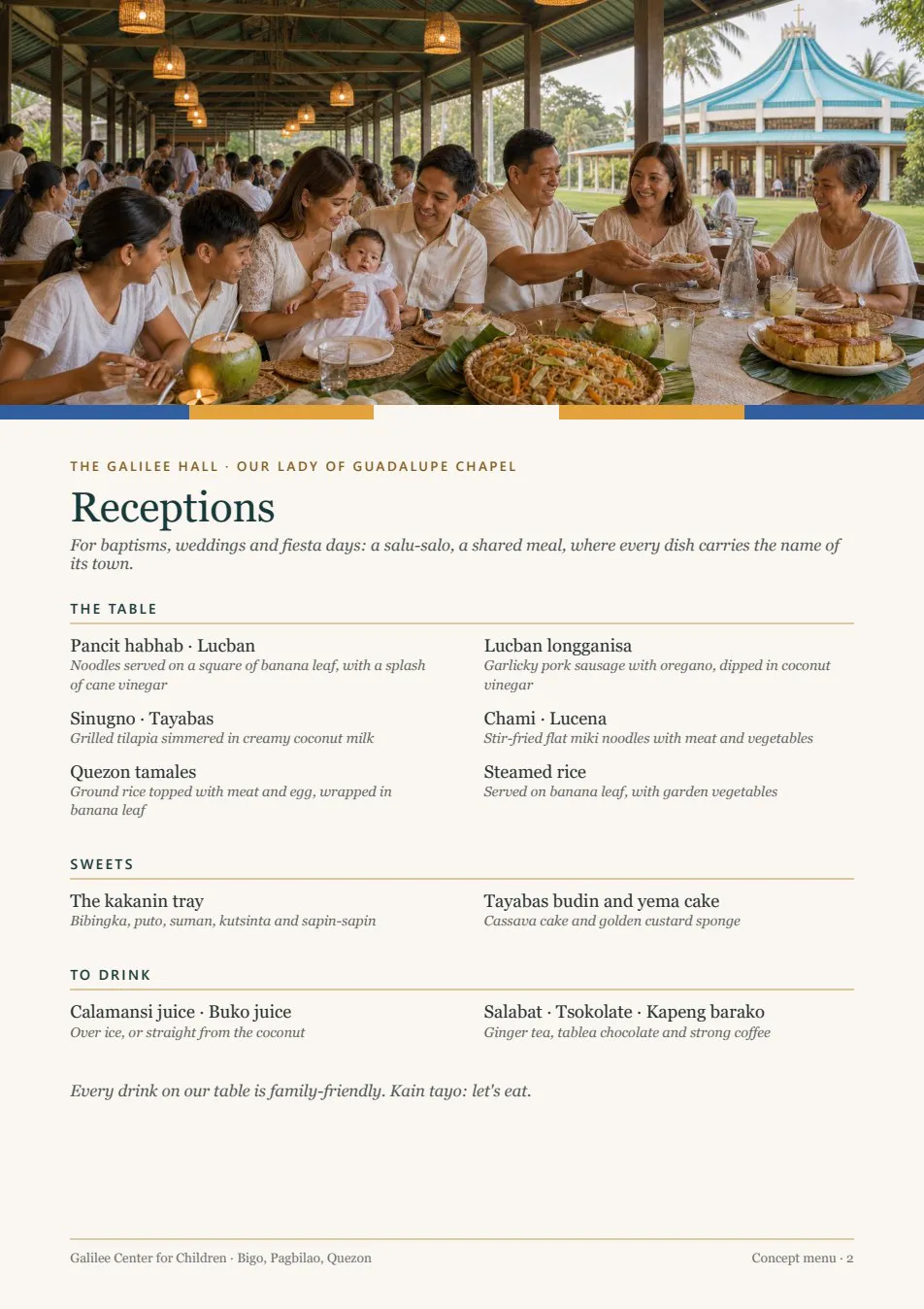
Today a baby has been baptized, dressed in white, with a candle lit from the Easter candle. Now the whole family gathers under the hall’s high green roof for a salu-salo, a shared meal.
The godparents, the ninongs and ninangs, have promised to help this child grow in faith. They are the proudest people in the room. Long tables, banana leaves, cane lamps, and through the open side, the turquoise roof of the chapel. Kain tayo. Let’s eat.
The home’s own hall: a steep green roof over an open floor on sturdy posts, so the breeze moves through and long tables seat the whole family.
Rice cakes and noodles
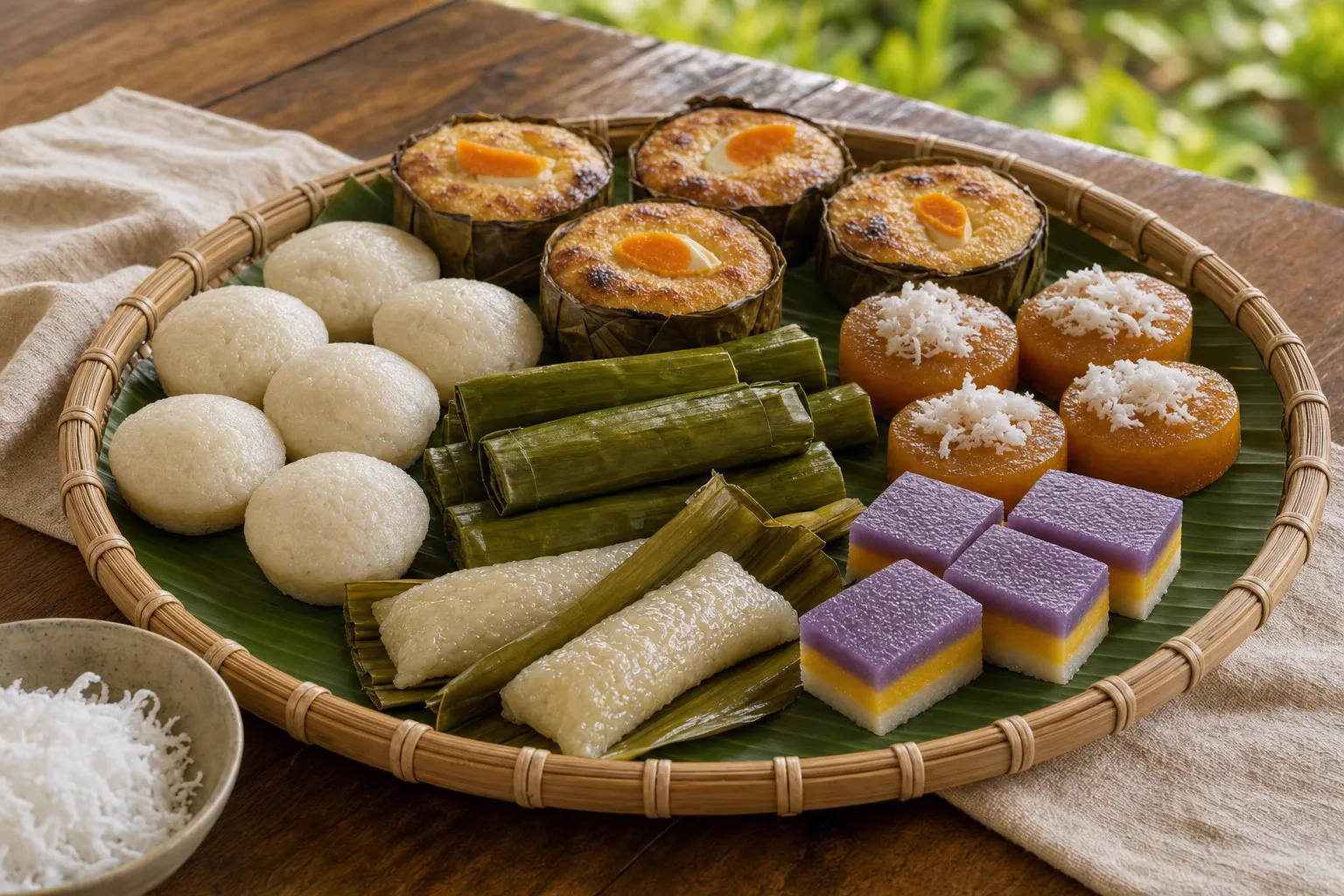
The rice cakes of merienda
Merienda is the beloved Filipino in-between meal. On the tray: bibingka baked over charcoal and topped with salted egg, little white puto, suman wrapped in banana leaf, chewy brown kutsinta with grated coconut, and bright layers of sapin-sapin.

Pancit habhab
Lucban’s pancit habhab is noodles served on a square of banana leaf and eaten straight from the leaf, no fork needed, with a splash of cane vinegar. A true Lucban favorite.
Flavors from next door

Budin and yema cake
Tayabas budin is Quezon’s cassava cake, made with coconut and topped with cheese, sold along the town’s Calle Budin. Beside it, Tayabas’s soft yema cake, crowned with golden custard, best with a cup of thick tablea chocolate.
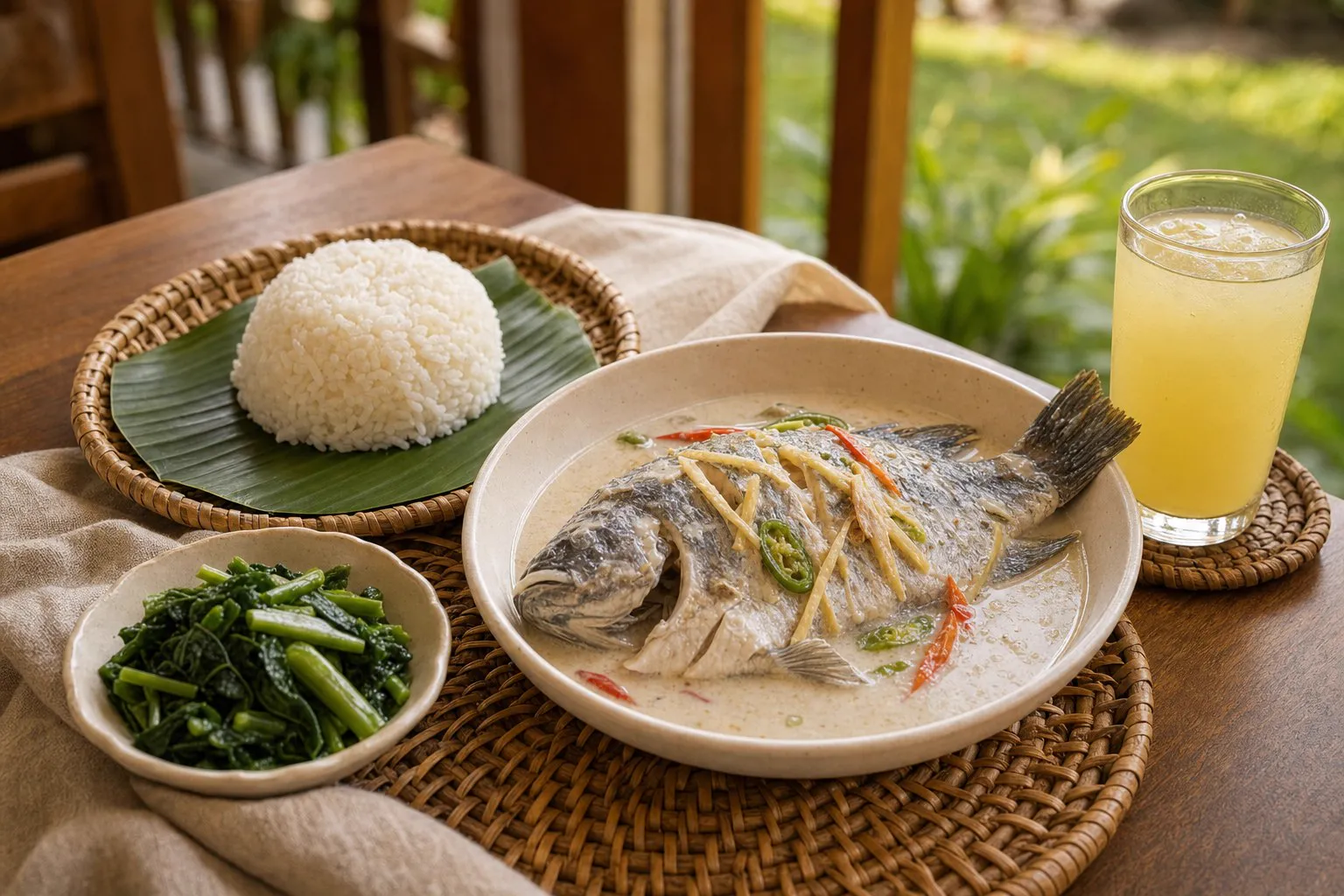
Sinugno for the reception
For a reception lunch, there is sinugno, a Tayabas favorite of grilled tilapia simmered in creamy coconut milk, served with rice on banana leaf. Every dish carries the name of its town, so every plate tells a little story of Quezon.
Merienda, receptions and drinks
The menu follows the life of the chapel: merienda after Sunday Mass, receptions for baptisms and weddings, and fiesta days on the lawn.
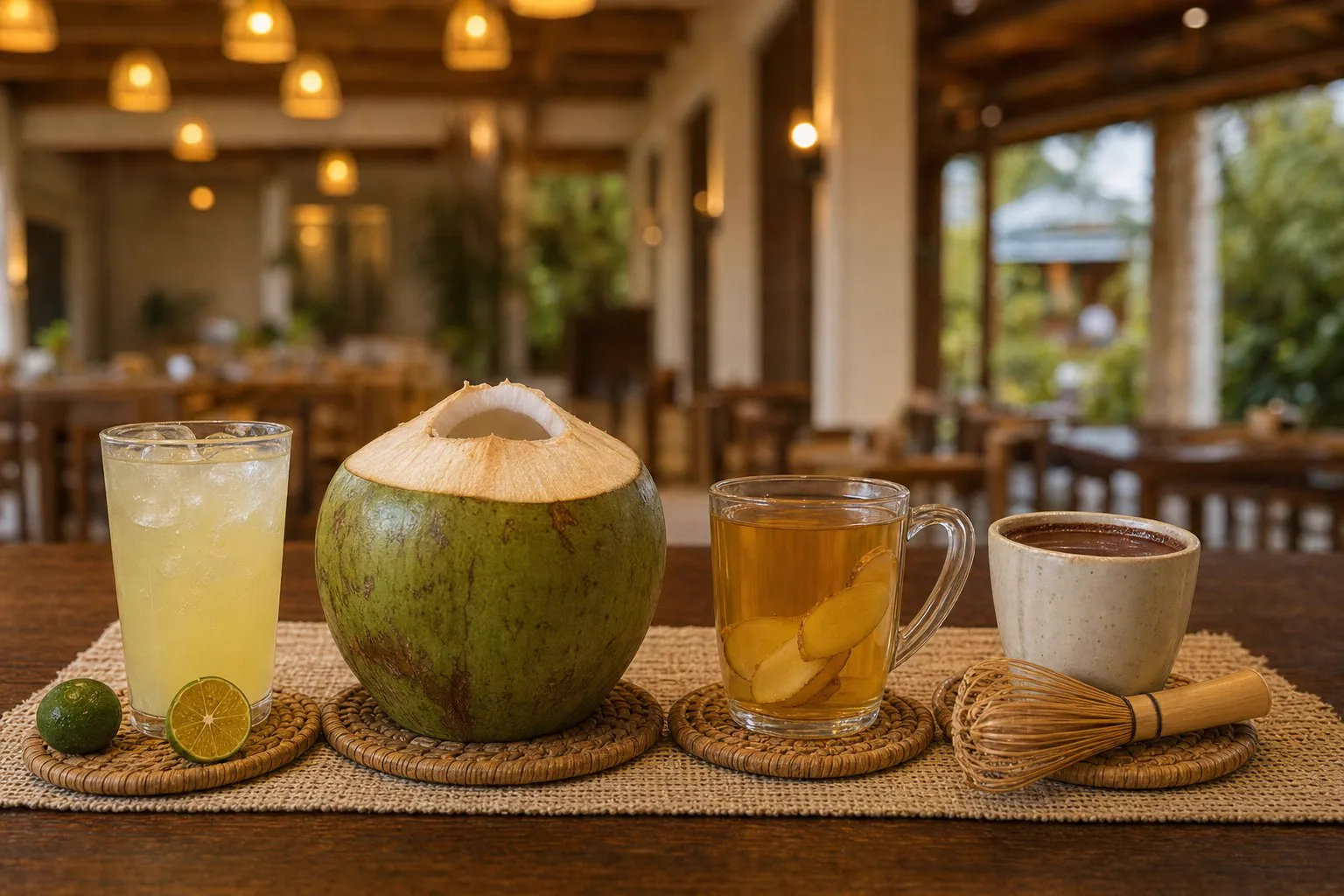
To drink: calamansi juice over ice, fresh buko juice, golden salabat ginger tea, thick hot tsokolate and strong kapeng barako from our neighbors in Batangas.


Coffee after Mass
On Sunday mornings, the hall becomes the parish living room.
A volunteer pours coffee and salabat, trays of bibingka and puto make the rounds, and neighbors who sat in the same rows during Mass catch up on the week. This is where a congregation becomes a family.
Something to carry home
Each keepsake comes from the chapel itself: its candles, its garden, its windows. The rosary walks through the life of Jesus with Mary in four sets of Mysteries, Joyful, Luminous, Sorrowful and Glorious.

Votive candles
Hand-poured in amber and honey glass, for a prayer at home, packed in a kraft box with a woven cane band.

Rosaries
Warm wooden beads and pearl-white beads, each with a simple crucifix. In Filipino homes, the family rosary keeps an old promise: the family that prays together stays together.
Prayer cards
Estampitas painted from the chapel’s own windows, the Good Shepherd, Juan Diego, Saint Joseph and Saint Francis, with a fifth card of Our Lady of Guadalupe from the wall behind the altar. Catholics have carried little images of Mary and the saints since the 1400s, as a reminder to pray.
Life’s big days
The doors open, and a bride and groom step out into a shower of white petals. Inside, the groom poured the thirteen coins of the arras into the bride’s hands. Their sponsors lit the candles, then draped the veil and the cord over the couple, a sign of a bond that holds. Now the whole family follows them out into the golden light, and on to the Galilee hall for the reception.
Solihiya at Narra
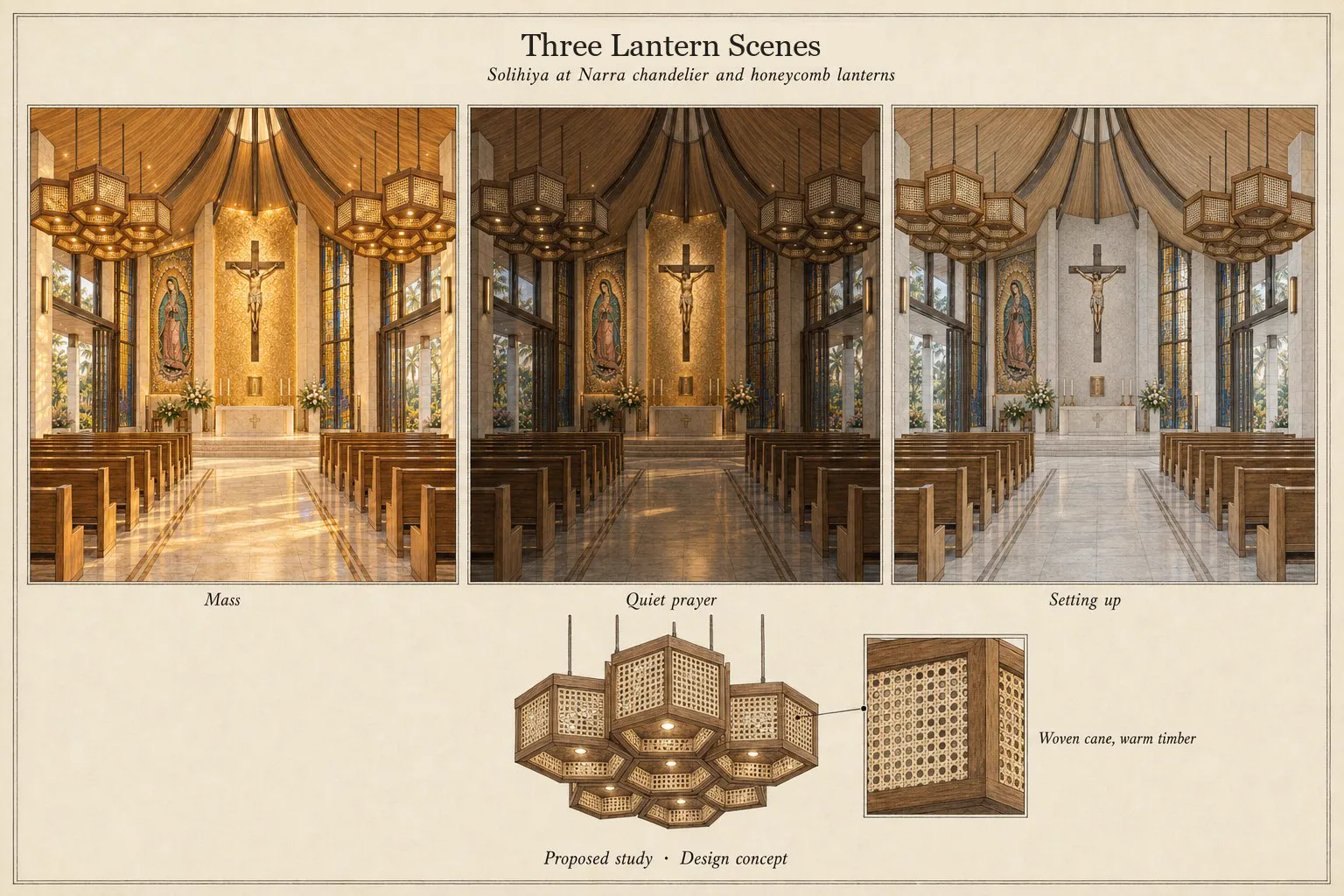
As evening falls, the lanterns wake. The chandelier joins warm narra-toned timber with panels of solihiya, the Filipino sunburst weave of split rattan that lets air and light pass right through.
Three lighting scenes serve the chapel: bright for Mass, soft for quiet prayer and clear for setting up.

Narra has been the national tree since 1934. The chapel’s narra comes from registered plantations and reclaimed wood.
Lanterns at dusk
Step out to the sampaguita walk at dusk and turn around. The whole chapel glows from within: the amber band, the open doors, the lanterns, the cross on the crown.
December will be this chapel’s season. On the twelfth comes the feast of Our Lady of Guadalupe, with roses from the garden on her altar. Four days later, Simbang Gabi begins, nine dawn Masses from the sixteenth to Christmas Eve, a tradition that came from Mexico with the missionaries, followed by bibingka and puto bumbong in the cool of the morning.
Where our visitors sleep
Below the chapel, a lantern-lit path leads down the hill to three small lights.
These are the guest houses, three homes for visiting families, set into the hillside. Each one climbs the slope in three terraces, held by curved stone walls, and a stair winds round the hill between them.

Three terraces, one hill
On the sheet, a turf roof planted with grasses keeps the sun off the roof and softens the rain, and the hillside stays at the back. Stone walls hold every terrace, with a drain hidden behind each wall.
Timber slat screens and sliding glass open to the view. The bedroom sits on the top terrace, the living room on the middle one, and a deep roof edge sheds the rain.
It is old wisdom, from the turf roofs of Norway and the nipa roof of the bahay kubo, brought to a coconut hill in Quezon.
In a Singapore test bed, a planted roof ran 7.3 °C cooler at the surface than a bare one, and the rain ran off it more slowly.
A room with the chapel above

Three homes on the hill
From every terrace you look up to the chapel’s crown. In the evening the windows glow like lanterns on the hill.

A terrace at first light
In the morning you wake to roosters and mist in the valley, a short walk from Mass. A bedroom on the top terrace, a living room on the middle one, and a deep roof edge for the rain: a home for one visiting family.

The day the chapel is blessed
And one day soon, the chapel will be blessed.
The bishop or his priest will sprinkle the room with holy water, bless and incense the new altar, and celebrate its first Mass. From then on, this room belongs to God, and to everyone who comes to pray.
Prepare the place · raise the shelter · complete the room · furnish for worship · bring in the art · welcome the community.
Hanggang sa muli, and come home soon
Thank you for walking with us today.
On the dashboard rests a sampaguita garland, still fragrant. In a pocket, a prayer card of Saint Juan Diego. The lanterns glow behind you through the palms as the car turns onto the village road.
Come back for Sunday Mass, for the feast in December, for a baptism, a wedding, or a quiet hour with Our Lady.
A place for prayer. A home for belonging.